
AI for Trucking Dispatchers: What's Real, What's Vapor, and What's Worth Paying For
An honest take on AI for trucking dispatchers in 2026. What actually saves time today, what's still a pitch, and how to evaluate any 'AI dispatch' claim.
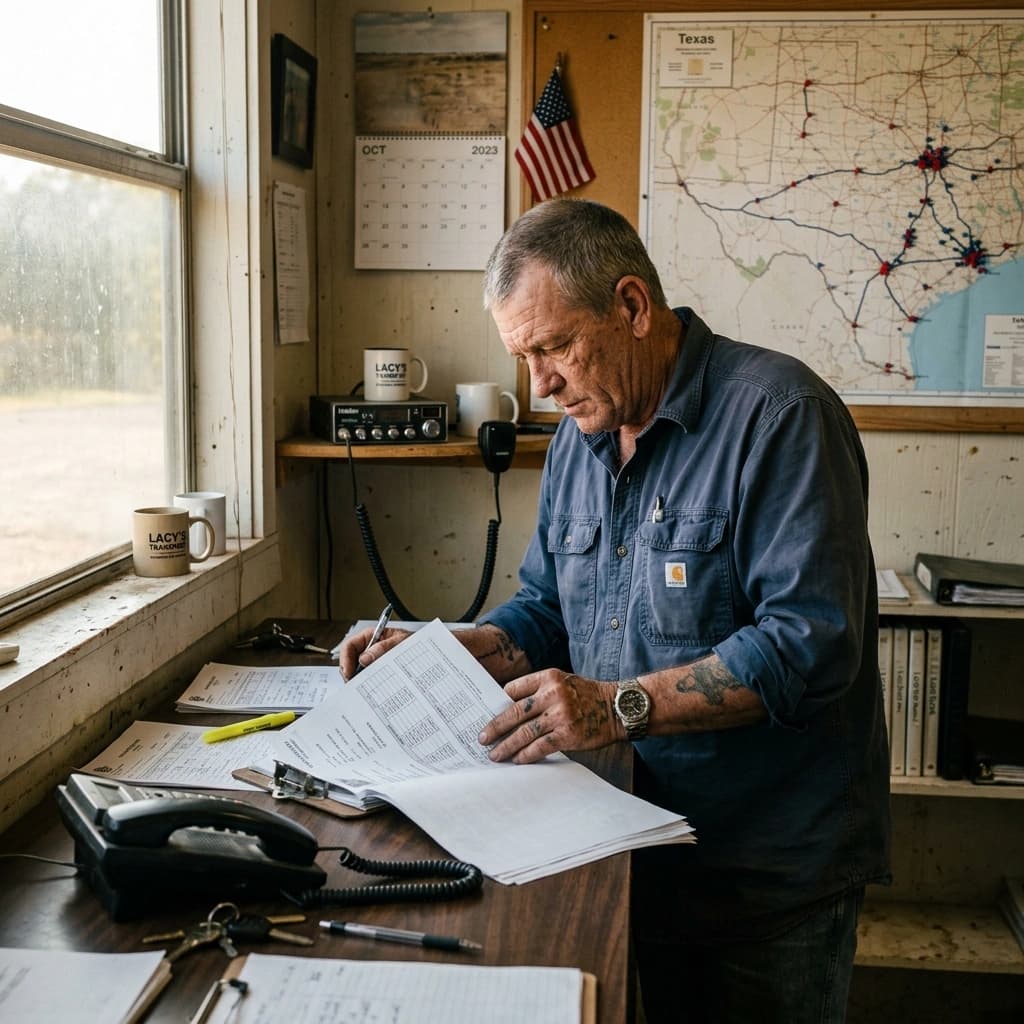
Most "AI for trucking dispatchers" you read about right now is a press release. Some of it is real. The honest cut between the two matters, because a dispatcher running 18 trucks does not have an afternoon to waste on demos that turn out to be a chatbot bolted onto a load board.
This is a working dispatcher's guide to where AI is actually useful in dispatch today, where it is still vapor, and what to ask a vendor before you pay them a dime. Howdy Dispatch ships an AI dispatch platform so we will name our own boundaries too. We are not pretending we do everything. We have one live AI capability shipped and a second one rolling out soon. The rest of the AI roadmap is on the roadmap, not in your account.
For the record, this is not about long-haul autonomous trucks, AI HOS compliance products, or freight matching. We are talking about the dispatcher's actual day. The desk, the rate cons, the driver texts, the BOLs, the broker emails. Where AI helps. Where it does not.
What the dispatcher's day actually looks like
Before we can decide where AI helps, we have to be honest about where the time goes. A small-fleet dispatcher running 5 to 50 trucks usually loses the most time in five places:
- Retyping broker rate confirmations into the dispatch board, every single load.
- Chasing drivers for pickup and delivery photos, because the broker needs them and the driver forgot.
- Rejecting blurry or cropped BOL photos two weeks later when the broker disputes the invoice.
- Texting drivers "where are you" because there is no live map.
- Hunting through Outlook, iMessage, and a paper folder to find a document for a load from three months ago.
That is the baseline. Any AI capability that does not measurably remove time from one of those five buckets is, for our purposes, vapor. Pretty demos do not move trucks.
What "AI for dispatchers" actually means today
There are roughly four categories of AI being pitched to dispatchers right now. They are not equally real.
1. AI that reads broker rate confirmations and pre-fills the load
This is the most useful AI we have shipped, and it is genuinely real. When a broker sends a rate confirmation PDF, the AI extracts the customer, origin, destination, mileage, rate, pickup and delivery datetimes, and broker contact info. It auto-matches the customer, driver, and truck against your address book. Google address validation runs on origin and destination. The dispatcher reviews and saves. Five to ten minutes of typing becomes about twenty seconds of review.
The reason this category is so useful is that it removes a high-frequency task. A dispatcher booking 8 loads a day saves close to an hour. Over a week, that is the difference between catching up on customer calls and going home at 8 p.m.
This is what we mean when we say Howdy is an AI dispatch platform. AI rate-confirmation intake is the live capability shipped on the HQ side. It runs on Google Vertex AI for accuracy on dense PDF layouts.
2. AI that checks driver photos before they leave the dock
The second category is photo quality QA at upload time. Every load and POD photo the driver uploads gets checked for blur and legibility while the driver is still at the dock. If the photo is unreadable, the driver reshoots before driving off.
This is the kind of AI that looks small and saves you a month of receivables. A blurry BOL photo is the reason a broker disputes an invoice three weeks later, and disputed invoices age. We are shipping this next on the driver iOS side. It is not in your account today, but it is the next AI capability we will move from roadmap to live. Anyone pitching this as fully shipped right now should be asked to show it working at a real loading dock, not a demo video.
3. AI that promises to "automate dispatching"
This is the category most likely to be vapor. Real autonomous dispatching, where the AI accepts loads from brokers, assigns drivers, and routes trucks without human judgment, is not a product you should buy in 2026 for a small or mid-size fleet. The reason is not technology. The reason is liability.
A dispatcher is the person who knows that this broker pays in 28 days, not 45. That this driver had a rough week and should not run a tight Atlanta to Birmingham turn. That this lane runs into a known scale issue on a Friday afternoon. AI does not have those facts. The dispatcher does. Anyone selling AI that "replaces the dispatcher" is selling you a lawsuit.
What you can legitimately buy is AI that removes typing, chasing, and paperwork failures from your dispatcher's day. The dispatcher still decides.
4. AI that promises route optimization for small fleets
A common pitch is AI route optimization. For long-haul OTR carriers running known lanes, route optimization is mostly already solved by basic mapping software and the driver's own knowledge. The "AI" overlay rarely beats the dispatcher plus Google Maps plus the driver. For multi-stop local delivery, AI routing has more upside, but that is courier and last-mile territory, not the small over-the-road fleet we build for.
Howdy Dispatch does not do route optimization. We are not pretending we do. It is not on our roadmap and it is not a fit for our customers.
A plausible week with AI rate-conf intake live
Consider a small fleet of 12 trucks running mostly Texas to Oklahoma and Texas to Louisiana. The dispatcher receives an average of 9 rate cons a day from 5 brokers. Most are PDFs, some have header logos and footers, some are scans, all of them have the same data laid out in slightly different ways.
The "before AI" version of Tuesday morning:
- 7:30 a.m.: open Outlook, copy customer name into the dispatch board, retype origin and destination, look up mileage on Google Maps, paste rate, set pickup/delivery times, pick driver and truck from dropdowns. Five to seven minutes per load.
- Repeat eight more times.
- 9:30 a.m.: finally start answering driver texts.
The "with AI rate-conf intake" version of the same morning:
- 7:30 a.m.: drag the first rate con PDF onto the load creation screen. AI fills the customer (matched against the existing address book entry for ABC Carriers), the origin (validated by Google as a real warehouse address), the destination, the 487 mile route, the $1,847 rate, the pickup window, the broker dispatcher's phone number. Dispatcher reviews, picks the driver and truck, saves.
- Twenty seconds per load. Nine loads done in about three minutes.
- 7:45 a.m.: start answering driver texts.
That is the realistic outcome, not "AI runs your business." A specific feature, a specific failure prevented, a specific amount of time back.
What to ask any "AI dispatch" vendor before you pay
When a vendor pitches "AI for dispatchers," you do not need to be a technologist to cut through the marketing. Five questions handle most of it.
- Which specific feature is the AI doing? "AI-powered dispatch" is not an answer. "AI parses your broker rate confirmations and pre-fills the load" is. If the rep cannot name the exact feature, the AI is marketing copy.
- Is it shipped today, or is it on the roadmap? Ask them to point at the live product. If they say "in beta" or "coming next quarter," it is not live.
- What model is it running on? A real answer is "Vertex AI" or "Gemini" or "GPT" or "Claude." A non-answer is "our proprietary model." Custom models are fine, but the rep should be able to say what is under the hood.
- What happens when the AI is wrong? Every AI gets things wrong. The product question is what the dispatcher does next. The right answer is "the dispatcher reviews and corrects in seconds." The wrong answer is "it auto-saves and you find out later."
- Can I see it work on a real document, not a demo file? Ask the rep to run their AI on a rate con from your own broker, live. If it works on yours, it will work in your account.
We get all five of these questions ourselves. We answer them the same way. Live capability is rate-conf intake on the HQ side. Next live capability is photo quality QA on the driver side. Everything else is on the roadmap, not in your account.
What this is not
Howdy Dispatch is not an Electronic Logging Device under 49 CFR Part 395. We are not a freight broker, a carrier of record, or a freight forwarder. We do not verify FMCSA authority, safety scores, or insurance status. We do not autonomously dispatch. We do not do route optimization. We do not provide tax, legal, accounting, or regulatory advice.
What we are is the dispatch software with a driver app, built for small fleets, with AI deployed where it actually removes typing and prevents the most expensive paperwork failures.
The honest bottom line for a small fleet
For a 5 to 100 truck operation in 2026, the only AI that matters is the AI that gives your dispatcher hours back per week and prevents brokers from disputing your invoices. That is two specific features, not a vision deck.
If your dispatch board is still being typed in from Outlook every morning, AI rate-conf intake will pay for the software in week one. If your drivers are uploading photos that brokers reject weeks later, photo quality QA is the next thing to look for. Everything else can wait.
If you want to see Howdy Dispatch on your own rate cons before paying for anything, the 14-day free trial drops you straight onto the dispatch board with no credit card. Or, if you would rather talk to us about the founding-carrier program for fleets willing to push the roadmap with us, drop us a line.
Howdy. Let's haul.
READ NEXT
Record Rates, Same Office: What a Small Fleet Should Automate First
Trucking dispatch automation for small fleets in a record-rate market. What to automate first to cover more loads and lift throughput without a second hire.
Where Are My Trucks? Real Fleet Visibility for Small Carriers in a Tight Market
Fleet visibility for a small trucking company should not mean calling drivers every two hours. Here is what live GPS on the dispatcher map actually changes.