
Four Documents Win a Freight Dispute. Three of Them Die in a Driver's Camera Roll.
When a broker disputes an invoice, the carrier with the paperwork wins. Here is why BOLs and PODs vanish into a phone, and how a real driver app fixes it.
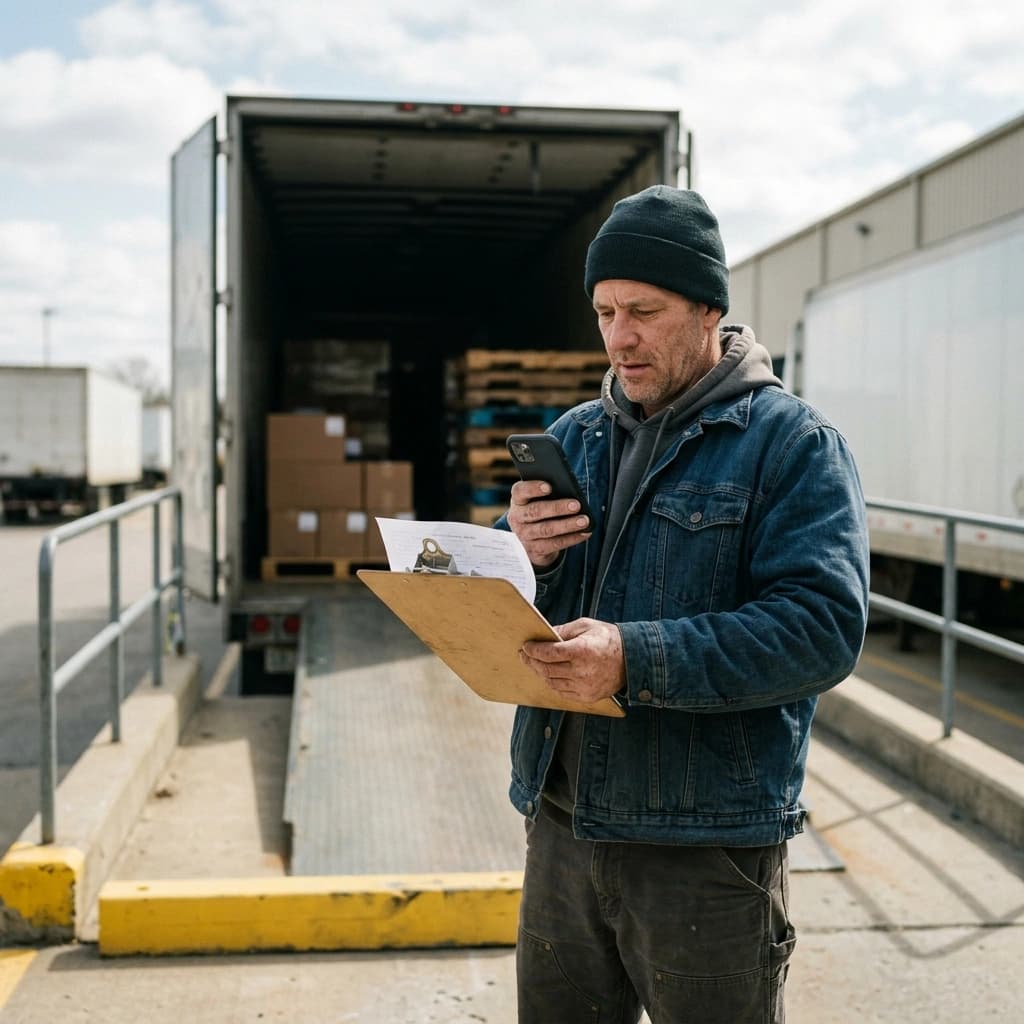
A broker disputes a detention charge on a Dallas to Memphis run. The load delivered three weeks ago. Now you are sitting at your desk, and the only way to prove the truck sat for four hours at the receiver is a photo of the bill of lading that your driver took on his personal phone. So you text him. He is mid-route. He scrolls back through a camera roll full of gas receipts, his kid's soccer game, and a hundred other loads, looking for one blurry picture of a piece of paper.
That is the moment a dispute is won or lost, and it has nothing to do with who is right. The carrier with the documentation wins. The one digging through a phone either loses the charge or eats hours finding the proof. In a 2026 freight market where margins are thin and every accessorial counts, that is real money walking out the door.
The fix is not working harder. It is structural. The documents that win a dispute should never live in a driver's camera roll in the first place.
Why disputes are won on paper, not on argument
Detention is the most disputed accessorial in freight, and the numbers are not in the carrier's favor by default. Industry analysis in 2026 found that roughly one in five detention invoices contains a billing error, which means brokers have every incentive to push back and see what sticks. When they do, the argument is not settled by who remembers the day correctly. It is settled by who has the paper.
There are four documents that decide a freight billing dispute: the rate confirmation, the bill of lading (BOL), the proof of delivery (POD), and the carrier invoice. Miss even one and the claim gets weak. The other side gets room to reject it. A complete, matching set leaves almost nothing to argue about.
Here is the quiet cost most small carriers never put a number on. The same 2026 analysis estimates that manually reconciling invoices and chasing documents runs about 2 to 3.5 hours a week, which works out to somewhere around $3,300 to $6,370 a year in operations time spent just searching for paperwork that already exists somewhere. That is a part-time problem you are paying full price for.
And that figure is only the time. It does not count the charges you quietly give up because the paperwork was too hard to find. When a broker pushes back on a four-hour detention claim and pulling the proof means a two-day text chase with a driver who is already on his next load, plenty of small carriers just eat it. The charge was legitimate. The documentation was technically somewhere. But the cost of proving it was higher than the charge itself, so it gets written off. Multiply that across a year of loads and the real number is bigger than the time-tracking math suggests.
The real failure: paperwork that never gets load-attached
Your drivers are not the problem. They pick up, they deliver, they snap the photo you asked for. The problem is where that photo lands.
A picture of a BOL sitting in a personal camera roll is not a record. It is a needle in a haystack. It is often blurry, it has no context tying it to a specific load, and the office cannot search it. The driver did the work, but the work did not become anything the business can use three weeks later when a broker calls.
So the dispatcher becomes the human integration layer. You are the connective tissue between the driver's phone, the broker's email, the rate con buried in your inbox, and the invoice you are trying to defend. Every dispute means another round of texts, another scroll through a camera roll, another reconstruction of a day nobody wrote down properly. The default small-carrier stack, Excel plus group texts, stores your most important paperwork in inboxes and personal phones, which is to say it stores it nowhere you can actually find it under pressure.
What a driver app fixes that a group text cannot
This is where a real driver app stops being a convenience and becomes the system of record. The difference is not a nicer interface. It is that every document gets attached to the load it belongs to, automatically, the moment it is created.
Howdy Dispatch is built on both sides for exactly this reason. Here is what is live today:
- One-tap capture at the dock. The driver takes the BOL and manifest photo at pickup and the POD photo at delivery, one tap each, and each photo attaches to that specific load automatically. No camera roll, no texting, no "which load was this again."
- Live GPS on the HQ map. Continuous tracking means pickup and delivery timing is on the record as it happens, not reconstructed from memory three weeks later when the detention clock is in question.
- A per-load document archive. Every BOL, manifest, and POD stays with its load and stays retrievable months later, when a broker disputes a charge or your insurance asks for proof. You open the load, the documents are there.
That is the whole game. The paperwork is attached to the load, not to the person, so it is there when you need it and it is there in seconds.
Think about what that changes on the day the dispute actually lands. The old way, a broker questions the Dallas to Memphis run and you start a small investigation: which driver, which day, which phone, scroll, squint, hope the photo is legible. The new way, you open the load. The BOL, the manifest, the POD, and the GPS trail of when the truck arrived and left are all sitting on the same record. You forward what you have in two minutes and the conversation is over. Same dispute, same broker, completely different outcome, because the proof was assembled automatically while the work was happening instead of reconstructed weeks later under pressure.
There is a second benefit that shows up quietly over time. When every load carries its own complete document set, the office stops being a bottleneck. A new dispatcher does not need to know which driver tends to keep good photos, or where last quarter's PODs ended up. The record is the record. That is what it means for a driver app to be the system of record rather than a nicer way to send a text.
Closing the loop on the fourth document
Three of the four winning documents come off the truck. The fourth, the rate confirmation, comes off your desk, and it is the one most likely to be retyped wrong under time pressure.
Howdy's dispatch software with a driver app handles that with AI rate-confirmation intake. A dispatcher uploads the broker's rate-con PDF, and the AI parses the customer, origin, destination, mileage, rate, and pickup and delivery times, then pre-fills the load. Five to ten minutes of typing becomes about twenty seconds of review. The agreed terms are captured cleanly before the truck even rolls, which means the document that anchors the whole dispute is right from the start.
One honest note about what is coming versus what is here. AI photo quality checking on the driver side, which would catch a blurry BOL at the dock while the driver can still reshoot it, is shipping next. It is not live yet. Today the win is that the photo gets captured and load-attached at all, instead of dying in a phone. The quality check is the next layer on top of a backbone that already works.
What you can do Monday morning
You do not need our software to start fixing this. The principle stands on its own: capture the BOL and POD at the dock, and keep them attached to the load, not the person. Whatever tool you use, that one habit turns "scroll through your camera roll" into "open the load." It is the single change that wins more disputes than any argument you could make.
To be clear about what Howdy Dispatch is and is not: it is not an ELD, it is not a freight broker, and it is not a compliance product. It keeps your paperwork tight and load-attached so the carrier with the documents, the one who wins, is you.
If chasing documents across phones and inboxes is costing you hours and lost charges, see the plans on the pricing page. There is a 14-day trial, and a founding-carrier program for early fleets through the contact page.
READ NEXT
Driver Incident Reporting App: The First Hour Decides
A driver incident reporting app captures the accident, breakdown, or DOT stop while the driver is still there. Why the first hour decides the paperwork.
Dispatch Software With a Driver App: Why You Need Both Sides
Most trucking dispatch software is an HQ dashboard drivers ignore, or a driver app with no HQ side. Why a small fleet needs both in one platform.