
Driver Incident Reporting App: The First Hour Decides
A driver incident reporting app captures the accident, breakdown, or DOT stop while the driver is still there. Why the first hour decides the paperwork.
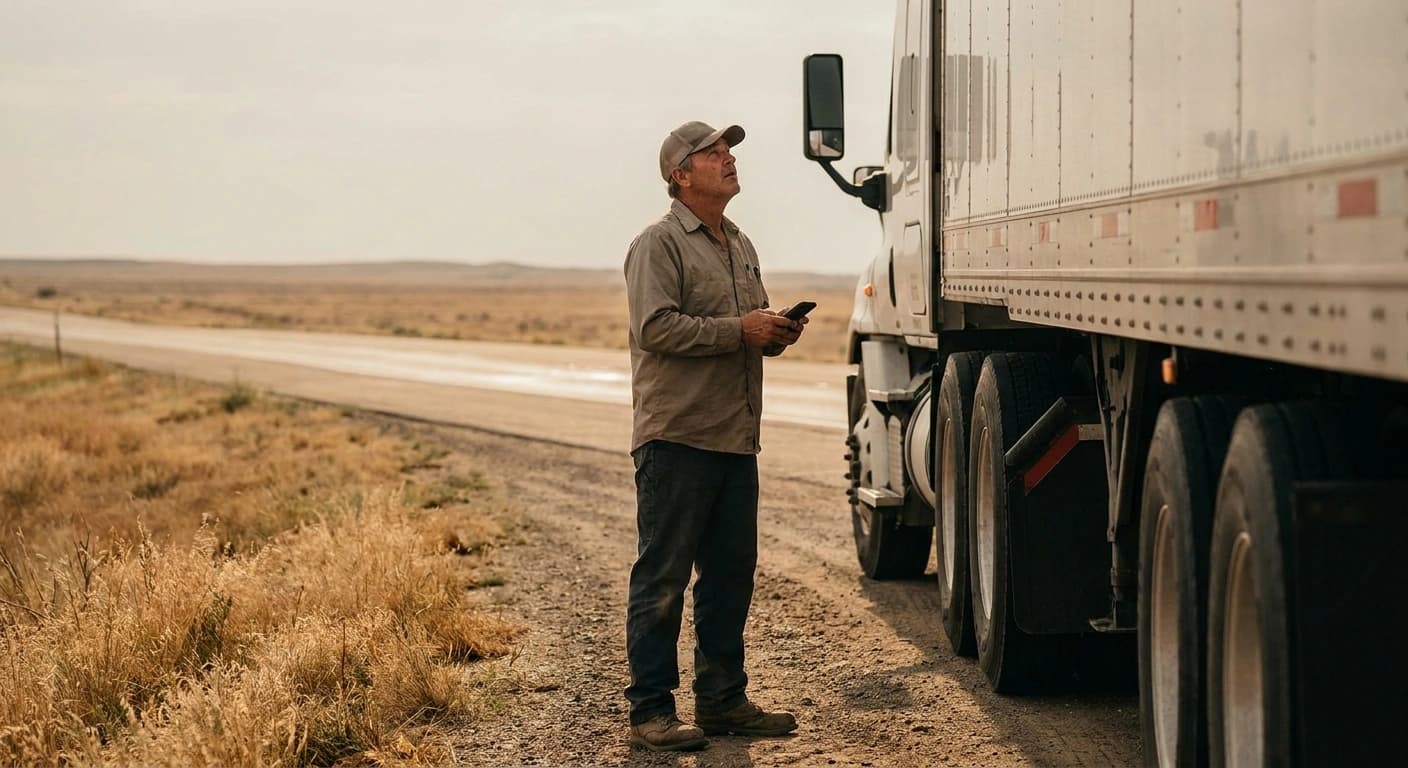
A driver incident reporting app is what a driver uses to log what happened, where, and when, with photos, attached to the load they are running, at the moment it happens. It replaces a phone call, a legal pad, and a camera roll. The operating claim underneath it is simple: what you can prove about an incident is decided in the first hour, by the person standing at the scene, not by the office three weeks later.
Every small fleet already has a post-incident process. It is a phone call. The driver calls dispatch, somebody writes a few lines down, the photos stay on the driver's phone, and the officer's name gets remembered wrong by the time anyone needs it. That process was fine when nobody asked. People ask now.
What is a driver incident reporting app, and what does it replace?
The category is narrower than it sounds. This is not safety software, and it is not compliance software. It is a capture tool for the moment something goes sideways mid-load.
What it replaces is a set of habits, not a product. Right now the record of a breakdown outside Tucson lives in four places: a voicemail, a text thread, forty photos in a camera roll sorted by date instead of by load, and whatever the dispatcher wrote on the legal pad before the next call came in. None of those places are searchable, and none of them are attached to the load the incident actually happened on.
The problem is not that anyone is careless. The problem is that reconstruction is a bad way to build a record. Memory degrades, phones get replaced, drivers leave, and the details that matter later are exactly the ones nobody thought to write down at the time.
Why does a thin incident file cost a small fleet more in 2026?
Because insurance is repricing, and underwriters read what you can show them.
The numbers are not subtle. Truck Writers, in a fleet insurance report published in June 2026 and updated in July, puts 2026 fleet insurance at roughly $550 to $1,500 per unit per month, with annual programs for a small non-fleet operator starting around $21,600. The same report cites ATRI's finding that insurance reached $0.102 per mile in 2024, which was the steepest single-year increase in the series at 12.1 percent. That 2024 figure is the latest published data and is reported on a lag, so read it as the trend rather than as this month's number.
At those levels, what a carrier can document about an incident stops being a filing chore. A fleet that can produce a structured record of what happened, when, and what it did next is telling an underwriter a different story than a fleet that can produce a recollection.
The same thing plays out with brokers. Cargo damage disputes are settled on photos and timestamps. If your evidence is a picture taken after the argument started, you are arguing about the argument.
Now the necessary disclaimers, because this topic sits next to several things we are not. Howdy Dispatch is not an ELD. It is not a freight broker or a carrier of record. It is not an insurer, and it is not a compliance product. Nothing here is legal or insurance advice. Better records do not guarantee a better renewal or a won claim. They change what you are able to say when someone asks, which is a real thing but a smaller and more honest one.
What actually goes wrong mid-load, and what should a driver capture?
The useful move is to decide the categories in advance, because nobody makes good documentation decisions while standing on a shoulder with traffic going by.
The real list is short:
- Accident. Anything involving another vehicle, property, or injury.
- Mechanical breakdown. The truck stops being a truck.
- Pulled over. DOT inspection or traffic stop.
- Cargo damage. Discovered at pickup, in transit, or at the dock.
- Weather delay. The reason the appointment gets missed.
- Theft attempt. Including the ones that fail.
- Medical event. The driver or someone else.
- Roadblock. Closures, protests, anything that makes the route impossible.
For a stop specifically, four fields do almost all the work later: who stopped you, their badge number, any citation number, and how it ended. Those are the four things people cannot recall accurately after a month, and they are the four things that get asked about.
For cargo damage, the rule is even simpler. Photos before the trailer doors close, not after. A photo taken at the dock while the freight is still visible is evidence. The same photo taken two days later during a dispute is a claim about a photo.
You can put all of that in place on Monday with a group text and a shared folder, and it would still be better than what most fleets have. The structure is the point, not the software.
Why does the dispatcher need to know now instead of at the end of the shift?
Because the value of the information decays fast, and most of it is gone by dinner.
Take a reefer running I-20 for a mid-size broker with a 4 p.m. appointment. The unit throws a code at 10 a.m. outside Abilene. Known at 10 a.m., that is a rescue: call the shop, call the broker, reset expectations while there is still a day left to work with. Discovered at 6 p.m., the same event is a missed delivery, a rejected load, an angry broker, and a conversation about who is paying for the freight.
Nothing changed about the breakdown. What changed was when the office found out.
There is a second reason, which is that the person the driver calls is often not the person who can fix it. The driver calls the dispatcher he likes. The dispatcher is on another line. The owner, who could authorize the tow, hears about it later. Anything that depends on one phone call reaching one person is a system with a single point of failure, staffed by someone who is driving.
The last piece is closure. An open incident that nobody has resolved needs to stay visible, or it turns back into somebody's memory. Most incidents are not resolved by the person who first heard about them.
How does Howdy Dispatch handle incident reporting?
A driver files the incident from the iOS app, against the load they are on, while it is happening.
The report types are structured and match the list above: accidents, mechanical breakdowns, pulled over, cargo damage, weather delays, theft attempts, medical events, and roadblocks. A pulled-over report carries dedicated fields for the officer, badge, citation, and outcome, so those four details get captured as data rather than as a sentence someone types from memory later. Photo evidence uploads straight from the phone and attaches to the load, with client-side compression so it goes through on weak LTE instead of hanging at the roadside.
When the report is created, a push notification fans out to every dispatcher, admin, and owner on the company at once. Nobody has to be the one person who got the call. On the HQ jobs page, an unresolved incident shows as a red chip and stays there until someone closes it.
The reason this matters more than a standalone incident app is where the record lands. The load already carries its rate confirmation, pickup and manifest photos, delivery photo, and GPS history. The incident goes into that same per-load file. When a broker asks about a delivery in October, the answer is in one place instead of assembled from four.
Worth being clear about what this is not. There is no DVIR here, no two-way chat, no ELD or telematics integration, no IFTA, no factoring, and no invoicing. AI photo quality checking, which flags a blurry BOL while the driver is still at the dock, is shipping next and is not live today. Incident capture on the driver side is normally an enterprise TMS module that a 12-truck fleet never gets to buy, and that is the gap this fills. It should not take a $50,000 contract to write down what happened.
The judgment stays with the driver and the dispatcher. The app just makes the record. You can see how it fits with the rest of the load file on our dispatch software with a driver app page.
The Monday version of this
If you take nothing else from this, take three decisions. They cost nothing and you can make them this week.
Decide what gets reported. Pick your categories and tell your drivers. Ambiguity about whether something counts is why things go unreported.
Decide who gets told. Not one person. If your process routes through a single dispatcher's cell phone, it fails on the day that dispatcher is at lunch.
Decide where the photos live. Anywhere except a driver's camera roll. Attached to the load is best, a shared folder named by load number is acceptable, and the phone is not.
Fleets rarely lose these arguments because they were wrong. They lose them because a year later, nobody can prove they were right.
Start a 14-day free trial and see what a per-load file looks like when the incident is already in it.
READ NEXT
Dispatch Software With a Driver App: Why You Need Both Sides
Most trucking dispatch software is an HQ dashboard drivers ignore, or a driver app with no HQ side. Why a small fleet needs both in one platform.
The Tech You Hand a Driver Is Part of the Job
In-cab technology and driver retention: why the app you hand a driver shapes whether he stays, and what a small fleet should fix in the first 90 days.