

Diesel Price Spike: What It Does to a Small Fleet's Margin
Diesel near $5.60 a gallon changes which loads pay. The margin math behind a diesel price spike for a small carrier, and the paperwork that gets it paid.
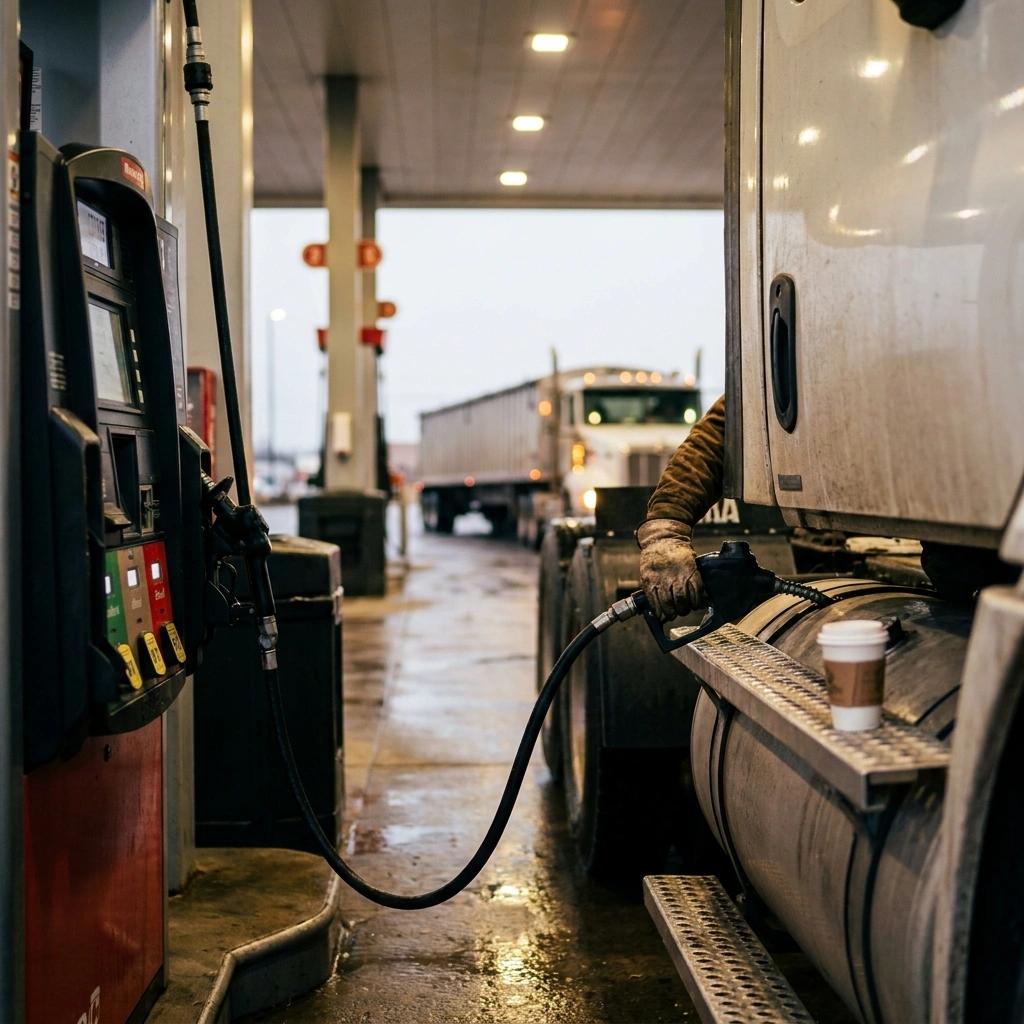
When diesel moves 34 cents a gallon in a month, a truck running 6.5 miles per gallon picks up about 5 cents a mile of cost on every mile it turns, loaded or empty. The American Transportation Research Institute put the industry's all-in cost at $2.336 a mile in 2025, with truckload and refrigerated operating margins below 1.0 percent. A fuel move that size is bigger than the margin.
The surcharge covers part of it on loaded miles. It covers none of it on deadhead, and none of it while the engine idles at a dock. So the loads that were thin in July are losing money in September, and a fleet only finds that out if it re-runs the math per load.
Here is a scene most dispatchers had in the last two weeks. A broker sends a rate confirmation for a lane you ran in July, same origin, same consignee, same rate. Nothing about the load changed. Everything about the load changed.
What does a diesel price spike do to a small fleet's margin?
The Energy Information Administration's weekly national on-highway diesel average went from $5.313 on July 27, 2026 to $5.652 on August 24, then eased to $5.599 on August 31. That is a rise of about 34 cents a gallon in four weeks, and 19.8 cents of it landed in the single week ending August 24.
Run that through a truck. At 6.5 miles per gallon, which is an illustrative figure and not data, 34 cents a gallon is about 5.2 cents a mile. On 10,000 miles in a month, that is roughly $520 per truck that was not in the budget. On five trucks it is $2,600.
Against a sub-one-percent operating margin, that is not a rounding error. It is the whole margin and then some, and it arrives on every mile at once rather than on the loads you choose.
How much fuel per mile are you actually paying right now?
ATRI's July 15, 2026 report lists fuel at $0.48 a mile for 2025, essentially flat against 2024. That is the number most dispatchers still carry in their heads, and it was accurate for the year it describes.
It is not what the pump charges today. At $5.60 a gallon and 6.5 miles per gallon, fuel is about 86 cents a mile. Plug in your own trucks and your own real mileage, because a loaded reefer pulling grades does not get the same number as an empty day cab on flat interstate. The point is the direction and the size of the gap, not the specific figure.
Here is the rest of the 2025 cost stack from the same ATRI data, as reported by FleetOwner on July 22, 2026:
| Line item | Cost per mile (2025) |
|---|---|
| Driver wages | $0.818 |
| Fuel | $0.480 |
| Truck payment | $0.280 |
| Repair and maintenance | $0.220 |
| Driver benefits | $0.210 |
| Trailer payment | $0.120 |
| Insurance | $0.110 |
| Tires | $0.050 |
| Tolls | $0.043 |
Fuel was the clear second line last year. At today's pump price it is fighting driver wages for first, and it moved there in about a month.
Worth noting what ATRI found underneath that: tolls rose 13.2 percent, repair and maintenance 8.6 percent, driver benefits 6.6 percent, and tires 6.4 percent. Fuel and driver compensation were the only two categories that grew slower than inflation. Every other cost was already climbing before diesel jumped.
Why does the fuel surcharge not cover it?
Contract surcharge schedules are indexed to a weekly national diesel average and pay out in bands. Two things follow from that. The index you get paid on is last week's number, so a 20-cent jump in one week is paid late. And bands are steps, so a move that lands inside a band pays nothing until it crosses the next one. Read your own schedule, because the index and the week it follows are negotiated and they vary.
Spot loads are different. The surcharge is baked into the all-in rate, and DAT's numbers for the week of August 30 to September 5, 2026, published September 8, show exactly how much. The national average van rate was $2.95 a mile all-in against $2.21 linehaul, so the fuel component was about 74 cents. Reefer ran $3.54 all-in over $2.74 linehaul. Flatbed ran $3.54 over $2.66. DAT's Dean Croke attributed roughly 3 cents a mile of the van increase and 4 cents on reefer and flatbed directly to that week's diesel move.
That is the honest version of the pass-through: the market did move, and it moved by cents while the pump moved by tens of cents on a per-gallon basis.
Then there are the two places the surcharge never reaches at all.
- Deadhead. Empty miles carry no revenue and no surcharge, and they burn fuel at the same price per gallon. If you have not worked out your empty miles per loaded mile, that ratio is the multiplier on every fuel increase, and we covered how to compute it in empty miles per loaded mile.
- The dock. A truck waiting three hours with the engine running is burning fuel nobody is paying for, on top of a driver's clock.
Which loads flip from paying to losing?
Total miles decide it, not loaded miles. The reload that needed 150 empty miles to reach was fine when fuel was 60 cents a mile and is a different question at 86.
Three shapes are worth pulling out of the board and re-checking before you accept anything else:
- Loads with a long repositioning leg. Price the deadhead at today's pump, not at the number in your rate calculator from spring.
- Loads on a rate quoted weeks ago with no surcharge line. A flat all-in rate agreed in July is a July rate being run on September fuel.
- Loads into facilities that historically run long, with no detention clause on the rate confirmation. Idle time is now fuel plus a driver's day, and without a clause you have no claim to make.
A workable Monday-morning rule: before accepting, read the surcharge line on the rate confirmation, count deadhead miles at today's pump price, and check the appointment window against the detention terms. Three checks, about a minute, and they are the difference between a load that pays and one that funds the broker's quarter.
What paperwork actually gets the surcharge paid?
The surcharge is a line on the rate confirmation. It gets paid when the invoice matches that rate confirmation, the miles match the trip that was actually run, and the delivery is proven. Miss any one of the three and the surcharge is the part that quietly comes off the check.
That is a document problem, not a fuel problem, and it is where dispatch software earns its keep. In Howdy Dispatch, the AI dispatch platform reads the broker's rate confirmation PDF and pre-fills the customer, origin, destination, mileage, rate, and pickup and delivery times onto the load for the dispatcher to review and save. The terms live on the load instead of in somebody's inbox. The rate confirmation, the bill of lading and the delivery photo stay in that load's document gallery. The GPS trail on the live map shows the miles the truck actually drove. The detention timer records pickup and delivery wait against the appointment window, with a grace period your company sets.
Be clear about what that is and is not. The parser extracts the rate and the mileage; it does not read or interpret the surcharge schedule, and a human dispatcher reviews every field before it saves. Howdy Dispatch is not an IFTA product, not a fuel card, not a route optimizer and not an ELD. It keeps the load file straight so the invoice can be defended. It does not buy your diesel cheaper.
The alternative most small fleets are running is the rate confirmation in Outlook, the miles in a driver's memory, and the proof of delivery on somebody's phone. That combination is how a surcharge gets short-paid: not because anyone disputed it, but because nothing ever proved it.
What to do this week while diesel sits near $5.60
Four things, in order.
- Re-price your cost per mile with the current pump price and your fleet's real mileage, not last year's average. The number you have been quoting is probably from before August.
- Sort your open loads by total miles, loaded plus empty, and re-check the thin ones against the new number.
- Read the surcharge terms on every open rate confirmation. Ask the broker which index it follows and which week. If they cannot answer quickly, that is information too.
- Keep the rate confirmation, the timestamps and the proof of delivery on the load so the surcharge gets paid on the first invoice instead of the third phone call.
None of that makes diesel cheaper. It does mean the fuel you already bought gets billed for, and at a margin under one percent that is most of the fight.
Diesel eased 5.3 cents in the week ending August 31, which is a reminder that these moves run both directions. The fleets that come out of it in one piece are not the ones that guessed which way it would go. They are the ones whose numbers were current and whose paperwork held up.
If you want the load file to keep itself together while you deal with the pump, Howdy Dispatch runs a 14-day free trial with no card required.

READ NEXT
Q4 Peak Season 2026: A Small Carrier's Dispatch Plan
Q4 peak season for a small carrier in 2026: trucks are short, ratios are up, and diesel peaked at $6.53. What a 5 to 20 truck fleet changes in dispatch now.
Empty Miles Per Loaded Mile: What Deadhead Costs Now
Empty miles per loaded mile is the number most small fleets never run. With rates and costs both at record levels, here is the math and what it changes.