

Driver GPS Tracking Off Duty: Where the Map Should Go Dark
Driver GPS tracking off duty costs a small fleet trust and clean data. A shift clock that turns the map off at clock-out keeps both. Here is how to set it up.
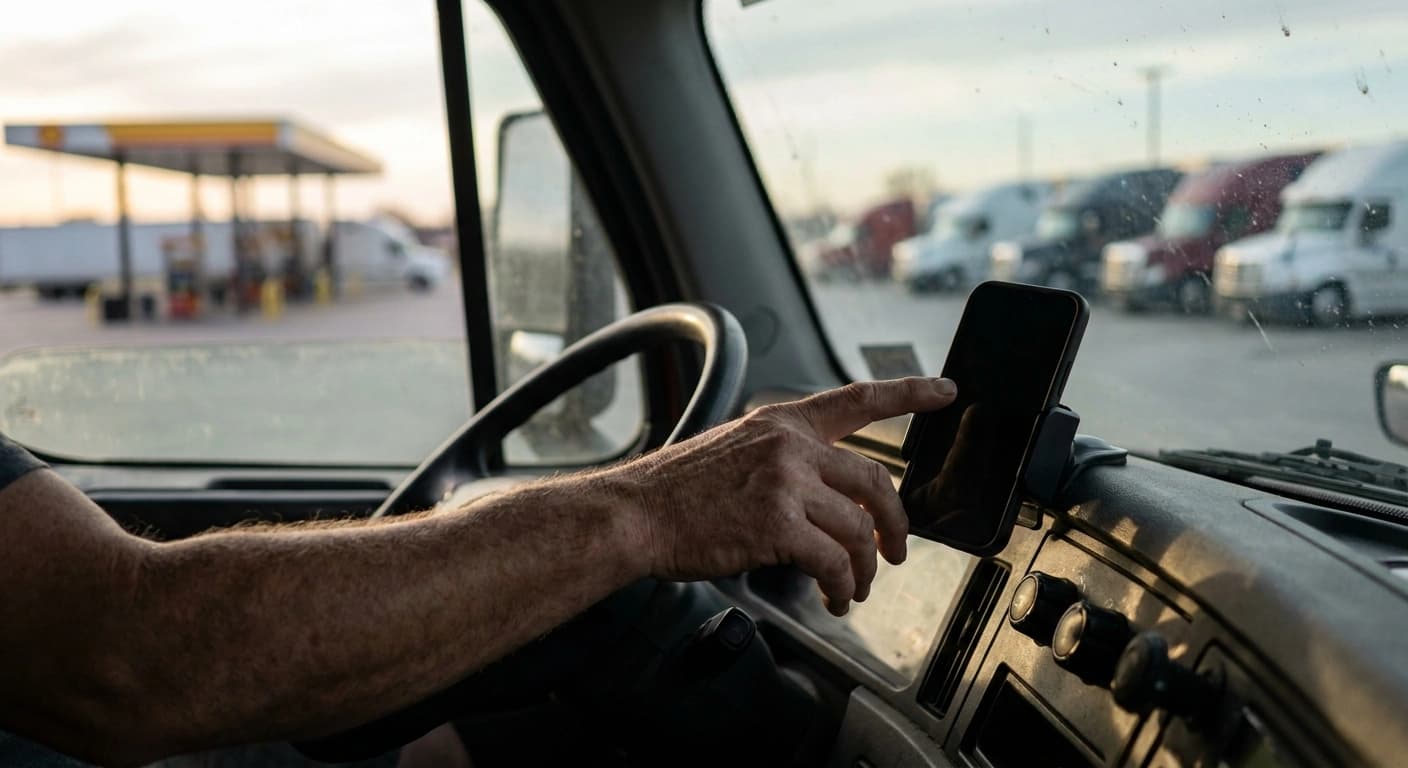
Should a dispatch app track drivers off duty? No. A dispatch app should track the truck while the driver is on the clock and stop the moment they clock out. The right switch is a shift clock in the driver's hands, not a setting buried somewhere in the dispatcher's dashboard.
That question is getting sharper this fall for two reasons. Drivers are scarce enough that a small fleet cannot afford to give one a reason to leave. And California has a workplace surveillance bill sitting on the Governor's desk that names geolocation in its definition of a surveillance tool. This post covers why off-duty tracking hurts a small fleet, what that bill actually says, how to write a one-page tracking policy this week, and how the shift clock in our driver app enforces it.
Why does off-duty tracking cost a small fleet drivers?
Picture a 10-truck flatbed outfit running regional lanes out of Amarillo. The dispatcher, call her Dana, set everyone up on a phone-based tracking app last spring. It works. She can see every truck on the map.
It also keeps working on Saturday. One of her drivers, call him Luis, is home for the weekend. The app is still running on his phone. On Monday the owner mentions, in passing, that he noticed Luis was out at the lake. It was meant as small talk. Luis heard it as being watched on his own time.
Nobody broke a rule. Nobody meant anything by it. And now the best driver in the yard is reading job boards on his lunch break.
Most dispatchers can tell a version of that story, and in this freight market it is an expensive story to live through:
- ATRI's Operational Costs of Trucking report, released July 15, 2026 and covering 2025, found that carriers left 10 percent of trucks unseated on average, reduced truck counts by 2.4 percent, and ran truckload and refrigerated operating margins below 1.0 percent. The industry-average cost to run a truck was $2.336 per mile.
- Arrive Logistics' September 2026 freight market update puts the U.S. Class 8 tractor fleet 1.6 percent below year-ago levels, with carriers renewing aging equipment rather than adding capacity.
When margins sit under one percent and a tenth of trucks already have nobody in the seat, a driver who leaves is not a morale problem. It is a truck that stops earning.
Why is 24-hour tracking bad data, too?
There is a second cost that has nothing to do with feelings. When an app tracks the phone instead of the shift, the map fills up with trips that are not loads.
The driver who takes his personal pickup to the feed store shows up as a moving dot. The driver who carries his phone into a restaurant on a 34-hour restart looks like a truck parked at a restaurant. A dispatcher glancing at the board cannot tell which dots are working trucks and which are people living their lives.
After a few weeks of that, dispatchers stop trusting the map and go back to calling drivers. That is the exact habit tracking was supposed to replace. Tracking only the working hours keeps the map honest, because every dot on it means a truck on the clock.
What does California's AB 1331 actually cover?
AB 1331 is a California workplace surveillance bill. Here is its status and what the current text says, checked against the California Legislative Information site on September 28, 2026:
- It passed the Senate 28 to 5 and the Assembly concurred 61 to 7 on August 31, 2026.
- It was enrolled on September 4 and presented to the Governor on September 14, 2026.
- It is on the Governor's desk. It is not law as of this writing.
The bill defines a "workplace surveillance tool" broadly, as a system that collects employee data or behavior "by means other than direct observation by a person," and it lists geolocation by name alongside video, audio, and time-tracking tools. It carries a penalty of up to $500 per violation.
It is worth being precise about what the current version does with that definition, because some older write-ups describe earlier drafts. The enrolled text we read is narrow. It bars employers from using a surveillance tool to monitor employees in a workplace bathroom, lets employees leave a tool on their person behind when they go into one, and lets employers check the tool for that one-time entry and exit. We found no off-duty tracking rule and no notice requirement in the current text.
So why bring it up? Because employee geolocation is now a named category in a bill that passed both houses of a large state legislature. The law will keep moving, and it applies to employees, which may or may not describe your drivers depending on how they are engaged. Howdy Dispatch is not a compliance product and this is not legal advice. Have your own counsel read the bill if you run employee drivers in California.
The point for an operator is simpler than any statute. Tracking only on duty is the design that holds up under almost any rule someone could write, and it is the design drivers already understand as fair.
How to write a one-page driver tracking policy this week
You do not need our software to fix this. You need four sentences, written down and handed to every driver:
- What we track and when. We collect truck location while you are on shift. When you end your shift, we stop.
- On duty only. We do not collect location on your days off, on your 34-hour restart, or on personal trips.
- What we use it for. ETAs to brokers and receivers, fewer check calls to you, and proof of pickup and delivery times when a load gets disputed.
- Who can see it. Dispatch and the owner. Nobody else, and we do not bring it up in conversation.
Put it on one page. Read it out loud at the next safety meeting. Have your own counsel look it over if you operate in a state with a surveillance or privacy statute. The fourth sentence matters more than it looks. The Monday small-talk moment in the story above breaks it.
A written policy is a promise. The harder part is keeping it when the app keeps running whether anyone remembers or not.
How the driver shift clock works in Howdy Dispatch
This is the gap our driver shift clock closes: the policy gets enforced by the app instead of by memory.
- The driver controls it. From the Howdy Dispatch iOS driver app, the driver starts a shift, takes a break, resumes, and ends the shift.
- GPS follows the clock. Location goes to the HQ live map only while the driver is on the clock. On break, GPS pauses until they resume. After they end the shift, nothing is sent. Off-duty drivers do not ping dispatch.
- It holds up on the road. While the driver is on the clock, background tracking keeps running through screen lock and backgrounding, so dispatch does not lose the truck when the phone goes in the cup holder.
- The day closes cleanly. When the driver signs the truck off at the garage, the truck flips to parked on the HQ side.
The result is a live map that shows working trucks and nothing else, which is better for the dispatcher reading it and fairer to the driver carrying the phone. It is one piece of an AI dispatch platform built on both sides: a real iOS app for the driver and an HQ for the dispatcher, with AI parsing broker rate confirmations on the HQ side so loads land pre-filled.
What the shift clock is not
Tracking and hours topics sit close to compliance, so here is the plain list:
- It is not an ELD. Our hours-of-service self-report is not FMCSA-certified ELD output, and the app says so. Keep your certified ELD.
- It is not a compliance product. It does not make you compliant with AB 1331 or any other law, and it is not legal advice.
- It is not a driver-scoring or coaching tool. No geofences, no idle alerts, no speed scoring. It starts and stops location with the shift.
- It is not route optimization, and it does not dispatch loads. The dispatcher still decides.
The map should go dark when the driver clocks out
Every small fleet wants the live map, and every good driver wants their weekend to be their own. You can have both, as long as the switch that controls tracking is the shift, and the driver is the one holding it.
Write the four-sentence policy this week. If you want an app that enforces it for you, start a 14-day free trial at howdydispatch.com/pricing and put the shift clock in your drivers' hands.
READ NEXT
Q4 Peak Season 2026: A Small Carrier's Dispatch Plan
Q4 peak season for a small carrier in 2026: trucks are short, ratios are up, and diesel peaked at $6.53. What a 5 to 20 truck fleet changes in dispatch now.
Driver Turnover Cost for a Small Fleet in a Tightening Market
Driver turnover cost for a small fleet: ATRI puts small-fleet turnover at 32% vs 70.7% at mega carriers. What one lost driver really costs a 10-truck fleet.