

Why Brokers Vet Small Carriers Harder in 2026
Broker carrier vetting tightened for small fleets in 2026 after a $604M verdict. What brokers check now, and how to be the carrier they can defend picking.
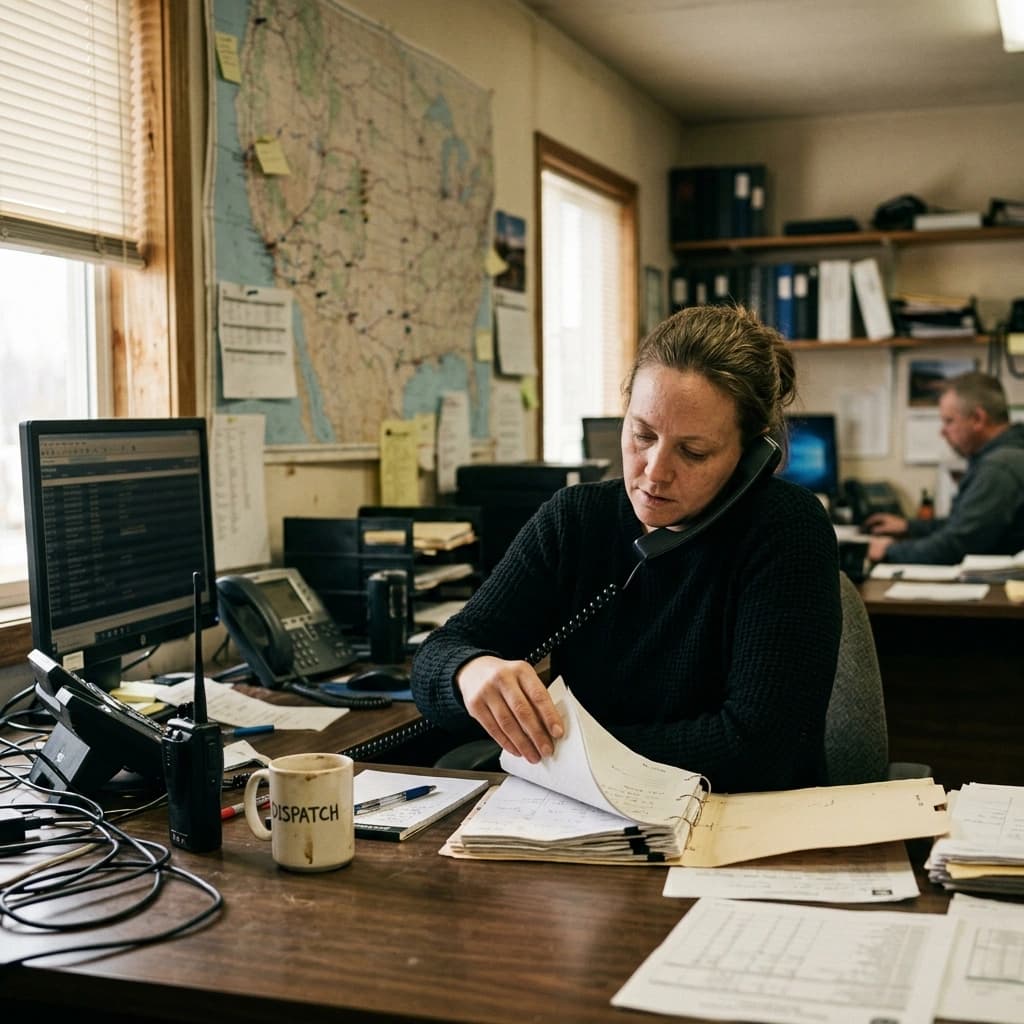
You have four trucks. The board is full. Rates are the best they have been in years. And you are still calling on loads you do not get.
That combination confuses a lot of small carriers right now, because every market report says this should be your year. Spot rates fell 2.2% to $3.20 per mile for the week ending August 14, according to Truckstop and FTR, and even after that dip they sit 38.2% above the same week last year. Capacity is tight. Freight is moving.
So when a five-truck fleet cannot fill its week in a market like this one, the problem usually is not the market. It is the file the broker pulls up when your MC number comes across their desk.
The load was never the hard part this year
Finding freight in 2026 is the easy half. Getting booked is the hard half, and the reason has more to do with what happened in a Texas courtroom in July than with anything on the load board.
Brokers have always screened carriers. What changed is the consequence of screening badly. That shifted the question a broker is answering from "can this carrier haul it" to "can I defend having picked this carrier." Those are not the same question, and the second one is answered with paperwork.
What changed on the broker's side of the desk
In July 2026, a Texas jury returned a verdict reported at $604 million in a case arising from a 2021 crash on Interstate 20 in Mississippi, a multi-vehicle pileup that killed three people. C.H. Robinson, the broker involved, has said it strongly disagrees with the verdict and will appeal. The case is Lipe v. Lupus Superior.
Take the appeal seriously when you read that number, because it may not survive. But the number is not really the point for a small carrier. The point is that every brokerage in the country read the headline, and their legal and risk teams went back through their carrier selection files to see what those files would look like held up in front of a jury.
The mechanism is worth understanding even though none of us are lawyers. When a broker can be held to account for which carrier it chose, carrier selection stops being a procurement decision and becomes a decision that has to be defensible later, in writing, to someone hostile. Brokers respond to that by tightening documentation and by routing freight toward carriers whose files look clean and complete.
Here is the sentence this whole post hangs on: documented, proactive compliance is now a business development asset, not just a DOT obligation. It used to be the thing you did so you would not get in trouble. It is now the thing that gets you the load.
There is regulatory movement pointing the same direction. The Safety and Accountability in Freight Enforcement Act, introduced in the House in February 2026 and with a Senate companion introduced in July, targets so-called chameleon carriers, operations that shut down and reopen under a new name and new DOT number to shed an enforcement history. The bill would direct FMCSA to develop and test automated screening for those reincorporation patterns. It is proposed legislation, not law, so nothing about it binds anyone today. But the direction of travel is clear enough: a clean, continuous operating history is worth more than it was two years ago, and the ability to show one matters as much as having one.
One thing to be plain about, since this topic sits next to compliance: Howdy Dispatch is not an ELD. It is not a freight broker or a carrier of record. It is not a compliance product, and it does not verify your operating authority, your safety scores, or your insurance. Nothing in this post is legal or regulatory advice. It is general operational information from people who build dispatch software.
What a broker actually checks before they book you
Most of the list is what you would expect, and it is worth knowing the order.
Active operating authority, and how continuous it has been. Not just active today. A history with gaps invites questions.
Insurance currency and certificate details. Is the COI current, are the limits right for the freight, and are the certificate holder details correct for this broker.
Safety history and roadside inspection record. Your record as it actually reads in the federal data, not as you would describe it.
Equipment match. Reefer freight needs a reefer, and the broker wants to see that you actually run what you say you run.
How fast you respond. This one gets skipped in every article about carrier vetting, and it should not be.
Responsiveness is a vetting signal whether or not that is fair. A broker with a hot load and a 4 p.m. pickup calls three carriers. The one who picks up gets asked for paperwork. The one who calls back in forty minutes gets told it covered. And in the broker's head, slow to answer the phone quietly becomes slow to answer when something goes wrong on the load, which is exactly the kind of carrier a risk-conscious brokerage is trying to avoid right now.
Here is a concrete one that is time-boxed and easy to check. On July 9, 2026, FMCSA removed 10 devices from its registered ELD list. Carriers running an affected device have 60 days to move to a compliant registered ELD. After September 8, 2026, a driver still running one of those devices is considered to be operating without an ELD, and enforcement is instructed to cite 395.8(a)(1) and place the driver out of service.
Think about how that reads to a broker. A carrier who does not know whether their device is on that list, three weeks out from the deadline, is precisely the carrier nobody wants to have picked.
The paperwork gap that costs small fleets loads
Picture a reefer run, Laredo to Dallas, 430 miles at $3.35 per mile. Good money. The broker is a mid-size shop you have hauled for twice before, and the rep is ready to book you. Then they ask for your current COI and the signed BOL from the load you ran for them in June, because their file is incomplete and their new process will not let them tender without it.
So where are those two documents?
The COI is in an email from your agent, sent in March, somewhere in an inbox with eleven thousand messages. The signed BOL is a photo your driver texted you at 9:40 at night from a dock in Garland. The last roadside inspection report is a picture on a phone that has since been replaced.
Notice what that is and is not. That is not a compliance failure. You are compliant. Your insurance is current, your driver got the BOL signed, the inspection came back clean. It is a retrieval failure. You can prove all of it, just not in the ten minutes the broker is willing to wait before moving to the next carrier on the list.
And here is the part that makes this so hard to fix on your own: the cost is invisible. Nobody calls to tell you that you lost a load because a document took two days to produce. The load just goes to somebody else, and your week is a little lighter than it should be, and you assume the market softened.
What to fix this week, with or without software
Four things, none of which require buying anything.
Read your own file the way a broker would. Pull your authority status and your inspection history and look at them cold, before a broker does. You cannot fix what you have never looked at.
Check your ELD against the revoked list now. The September 8 deadline is real and the out-of-service consequence is real. This is a fifteen-minute task.
Decide where a document lives when it is created, not when it is requested. Per load, not per driver's phone, not per inbox. The specific system matters less than the fact that there is one and everyone uses it.
Set a response-time standard for broker calls and hold it. Thirty minutes, whatever you can actually staff. Speed is the one vetting signal you can improve today for free.
Where a dispatch platform actually helps
This is the part where retrieval stops being a discipline problem and starts being a software problem.
Howdy Dispatch is an AI dispatch platform built for fleets running roughly 1 to 50 trucks. Three pieces of it matter directly to what this post is about.
AI rate-confirmation intake. You upload the broker's rate confirmation PDF, and the AI pulls out the customer, origin, destination, mileage, rate, pickup and delivery times, and the broker's contact details, then matches the customer, driver, and truck against your address book. What was five to ten minutes of typing becomes about twenty seconds of review. That is not just a time saving. It is response speed, and response speed is a vetting signal.
A per-load document archive. Pickup, manifest, and delivery photos, plus the rate confirmation, stored against the load they belong to. When a broker asks for the signed BOL from a June run, producing it is a lookup rather than an excavation.
Live GPS on the dispatcher's map. When a broker asks where the truck is, you answer, instead of promising to call the driver and get back to them.
Now the honest part. None of that vets you. It does not talk to FMCSA, it does not fix a safety score, and it does not make anyone compliant who is not. What it does is make what you already do retrievable, which turns out to be the thing standing between a lot of small fleets and the load.
An enterprise TMS solves this too, and solves it well, for carriers who can absorb $30,000 to $60,000 a year. The gap has always been for everyone below that line.
Be the carrier they can defend
The small fleets getting passed over in this market are usually not the unsafe ones. They are the ones who cannot show their work fast enough.
That is a fixable problem, and mostly a boring one. Know what your own file says. Answer the phone. Put documents where you can find them the day they are created. In a year when brokers are re-reading their own selection files, being easy to say yes to is worth more than it has been in a long time.
Start a 14-day free trial, or reach out about the founding-carrier program if you want to talk through how your operation runs today.
READ NEXT
The Broker Asked Where Your Truck Is. The Fleets That Answer in Ten Seconds Get the Next Load.
Brokers now expect real-time location and ETA, not a callback. Here is how a small fleet answers where is my truck in seconds and earns repeat loads.
Driver Onboarding: The First 90 Days Decide Retention
Industry reporting says about a third of new truck drivers quit within 90 days. Here is what a small fleet actually controls in those three months.