

Detention Time Tracking App: Start the Clock at the Dock
A detention time tracking app for truckers only helps if the clock starts at the dock. See what a usable record holds and how Howdy Dispatch keeps it.
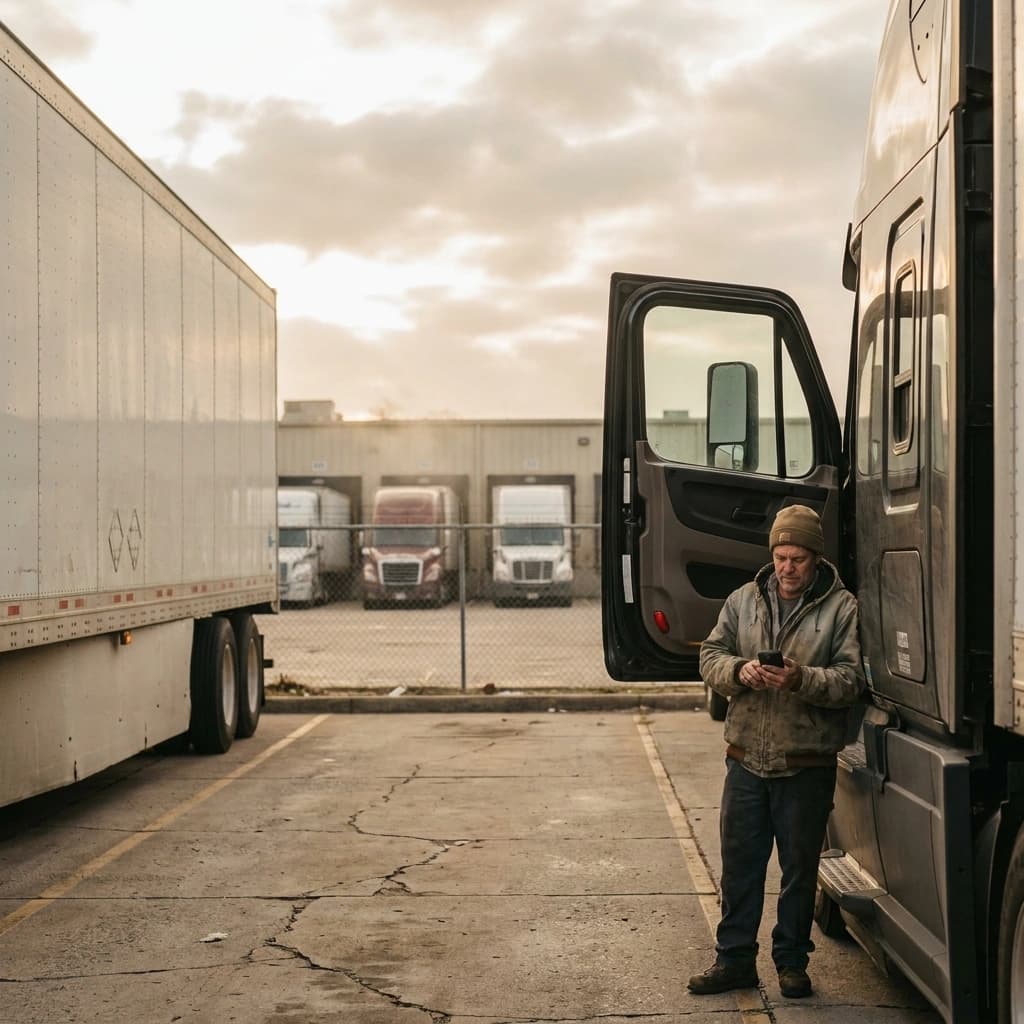
A detention time tracking app for truckers should record four things and tie them to the specific load: the appointment window, when the driver was actually waiting, the grace period that applied, and how long the wait ran past it. A detention claim is only as good as the record made at the dock, not the one pieced together from texts three days later. Howdy Dispatch tracks the driver's pickup and delivery wait time against the appointment window and saves the result on the job.
Most small fleets do not lose detention money because the broker refuses to pay. They lose it at the moment the clock should have started, because the only record is a driver's memory and a text that says "still waiting."
What should a detention time tracking app actually record?
Strip away the features and a usable detention record answers five questions about one load:
- What was the appointment? The pickup or delivery window the broker set, not the time the driver hoped to get in.
- How long did the driver wait? Measured against that appointment, at pickup and at delivery separately.
- What grace period applied? Usually two hours, but it should match the terms on your rate con.
- How far past free time did it run? That is the number the claim is actually about.
- Is it attached to the right load? A wait time that lives in a group text is not attached to anything.
If a tool cannot answer those five questions from the load itself, it is a stopwatch, not a record.
Why is detention back in the news in 2026?
On September 11, 2026, the Congressional Research Service updated its report on commercial trucking issues in surface transportation reauthorization (R48759). Detention time is on the list of open policy questions, next to broker transparency, insurance costs, and cargo theft, as Congress works on H.R. 8870, the BUILD America 250 Act, which the House Transportation and Infrastructure Committee ordered reported in May 2026.
A few lines from that report are worth knowing if you dispatch trucks:
- The two-hour line is a convention, not a law. The report describes an unofficial industry standard that treats detention as any time beyond two hours a truck dwells at a facility. The actual terms live in your contract or rate con.
- Detention eats the duty day. Wait time counts toward a driver's 14-hour duty window but not the 11-hour driving limit. Four hours at a dock is four hours of clock the driver cannot use to run.
- Drivers often are not paid for it, or are paid less than they would earn driving loaded.
- FMCSA is still gathering data. In September 2025 the agency proposed a three-year pilot with about 256 drivers who could extend their 14-hour window by up to three hours to offset detention.
Here is the plain read. Washington is still studying the problem. Nothing in that report changes what a broker owes you this week. This is not legal advice, and your rate con still governs your claim.
How much detention goes unpaid?
The most complete numbers come from ATRI's detention study, which used 2023 data and was published in September 2024. It is still the latest full study available, so treat these as 2023 figures, not this year's. As FreightWaves reported on the study:
- Drivers were detained at 39.3 percent of stops.
- Waits ran longer than four hours at 4.9 percent of stops.
- Carriers invoiced for detention only 75 percent of the time.
- Only 55 percent of those invoices were paid.
Look at the last two lines together. A quarter of detention never gets billed at all, and a large share of what does get billed never gets collected. Some of that is brokers pushing back. A lot of it is a paperwork gap: the carrier cannot show when the truck arrived, when the wait started counting, and when it left.
Where does a small fleet lose the detention claim?
Here is how it usually goes, with generic names.
Your driver is hauling a dry van load from Dallas to a grocery DC outside Memphis, about 450 miles. The rate con says two hours free at delivery, then detention at an hourly rate. The delivery appointment is 08:00. The driver checks in at 07:40, gets a door at 11:30, and is empty and pulling out at 12:15.
Many rate cons start the clock at the appointment time, not at arrival, so an early check-in does not add to the claim. Counted from the 08:00 appointment: that is 4 hours 15 minutes on site, minus 2 hours free, for 2 hours 15 minutes of billable detention.
Three days later you send the invoice. The broker asks for proof of in and out times. And here is what you actually have:
- A text from the driver at 09:52 that says "still waiting"
- A text at 12:20 that says "empty, heading to the truck stop"
- A BOL with a receiver signature and no times on it
- Nothing that shows the appointment was 08:00, other than the rate con in someone's inbox
That is not a record. That is a story. And a broker reviewing detention claims is going to treat it like one.
Notice where the claim died. Not at invoicing. It died at 10:00 that morning, when nobody wrote down when the wait was counting from, and again at 12:15, when nobody got an out time on the BOL.
What brokers usually ask for is spelled out in their terms: in and out times, often written and signed on the BOL, and notice once the free time is up. A tracking app backs your driver up. It does not replace what your rate con says you have to provide.
How does the Howdy Dispatch detention timer work?
The detention timer is part of the Howdy Dispatch AI dispatch platform built on both sides: an HQ side for the dispatcher and a real iOS app for the driver.
Here is what it does, stated literally:
- It tracks the driver's wait time at pickup and at delivery, measured against the appointment window on the load.
- It applies a grace period your company sets. If your standard is two hours free, set it to two hours. If you run a lane where the customer's contract says something different, that is your call.
- It snapshots the result onto the job, so the wait stays with that load's record instead of living in a text thread.
It sits next to the rest of the load's paperwork in the same place:
- The pickup photo and delivery photo the driver takes in one tap
- The manifest photo
- The driver document gallery on the job detail page
- Continuous GPS on the HQ live map
So when the broker asks for proof three days later, the dispatcher opens one load and has the appointment, the wait, and the photos together.
Now what it is not. The detention timer records the wait. It does not bill detention to the broker, generate an invoice, calculate what you are owed, or send anything to anyone. The dispatcher still makes the claim. Howdy Dispatch is also not an ELD, and this is not an hours-of-service record. Your ELD is still what counts for HOS.
What can a dispatcher do about detention this week?
These work with or without software. Start Monday.
- Read the detention clause before you accept the load. How many hours free, what hourly rate, and when the clock starts. If the rate con is silent on detention, ask before you book, not after.
- Note the appointment type. A set appointment and a first come, first served window get treated differently. Know which one you have before the driver rolls in.
- Get in and out times on the BOL. Have drivers ask the shipper or receiver to write them in and sign. This is the single cheapest habit that saves claims.
- Call the broker at the two-hour mark, not at invoicing. Many brokers require notice while the truck is still waiting. A heads-up at hour two is worth more than a perfect invoice on day three.
- Keep the record on the load. Whatever system you use, the appointment, the wait, and the photos should live on the same load, not across a text thread, an inbox, and a paper folder.
One more thing that helps the record from the start: when you drop a broker rate con into Howdy Dispatch, AI rate-confirmation intake reads it and pre-fills the load, including the pickup and delivery datetimes. The appointment is on the load record before the truck ever leaves the yard, so nobody has to dig for it when the claim goes in.
Stop losing the claim at the dock
Detention pay is still an open question in Washington. Detention records are not. The fleets that collect are the ones that can show when the truck arrived, what the appointment was, and how long the wait ran past free time, on the load, the same day.
If you want the wait recorded where the rest of the load lives, start a 14-day free trial of Howdy Dispatch. No card needed to try it on your next detention-prone lane.
READ NEXT
Q4 Peak Season 2026: A Small Carrier's Dispatch Plan
Q4 peak season for a small carrier in 2026: trucks are short, ratios are up, and diesel peaked at $6.53. What a 5 to 20 truck fleet changes in dispatch now.
Driver GPS Tracking Off Duty: Where the Map Should Go Dark
Driver GPS tracking off duty costs a small fleet trust and clean data. A shift clock that turns the map off at clock-out keeps both. Here is how to set it up.