

Roadside Inspection Documents Every Small Fleet Needs
Roadside inspection documentation for a small fleet: what your driver has to produce, what lives in the cab, and what has to be one tap away for dispatch.
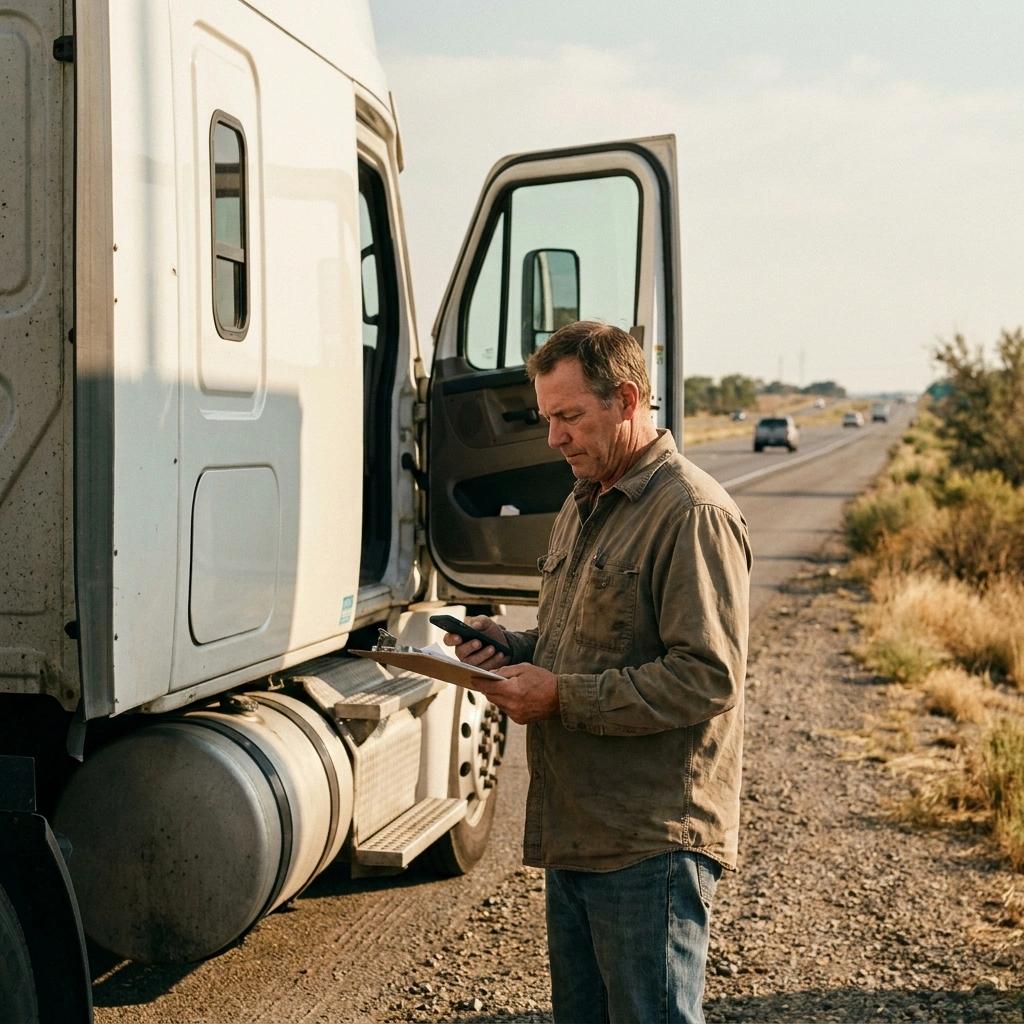
At a roadside inspection a driver has to produce three things: their credentials and hours of service, the vehicle and its inspection records, and the load paperwork. The officer cares about the first two. The third one decides whether the load still pays.
That split is the part most inspection advice skips. Compliance vendors write about citations, because citations are their product. A dispatcher running fifteen trucks has a second problem the citation checklist never mentions: an inspection is a load that stopped moving, and the clock on that delivery does not pause while the truck sits.
This is not compliance advice, and this platform is not an ELD. It does not log hours of service and it does not keep you legal. What follows is how a small carrier keeps the load side of an inspection from turning into a lost invoice.
Is your ELD one of the ten the FMCSA just revoked?
Start here, because there is a real deadline eleven days out.
On July 9, 2026, the FMCSA removed ten devices from its list of registered electronic logging devices. Carriers running an affected device got a 60 day window to replace it, which closes on September 8, 2026.
In the meantime, affected carriers are directed to stop relying on the revoked device immediately and keep hours of service on paper logs or compliant logging software until a registered device is installed.
After September 8, a carrier still running one of those devices is treated as operating without an ELD, and the driver can be placed out of service at the next inspection.
The practical step is small and worth doing this week rather than the week of the deadline. Pull up the FMCSA registered devices list, find your device by name and model, and confirm it is still on it. Most carriers running an affected unit have not checked, because nothing about the device looks different from the cab.
Out of service is an expensive place to learn this. Freight is not soft right now either. DAT reported in July 2026 that dry van spot rates had topped contract rates for the first time since February 2022, which is what a tightening market looks like. A parked truck costs more in that market than it did when capacity was loose.
What documentation does a driver actually need at a roadside inspection?
Split it by who owns it, because that is what tells you where it has to live.
Bucket one, the driver and the truck. CDL and medical certificate, the current record of duty status from the ELD, the cab card and registration, proof of insurance, the annual inspection report, and the most recent driver vehicle inspection report. This bucket lives in the cab and on the device. It is the bucket the officer is actually working through.
Bucket two, the load. Bill of lading, the manifest, any permits the commodity requires. Some of this the officer will glance at to confirm the truck is hauling what the paperwork says.
Bucket three, the money. The rate confirmation, the lumper receipt, pickup and delivery photos with timestamps. None of this appears on an inspection report. All of it decides whether the invoice survives a dispute three weeks later.
Most carriers have bucket one under control, because the consequences are immediate and obvious. Bucket three is where small fleets bleed, because the consequences arrive a month later and land on someone who was not at the roadside.
What paperwork belongs to the load, not to the officer?
Picture a reefer run out of a produce shed in Laredo, headed north, appointment at a DC the next afternoon. The truck gets a level two on the way up and the stop eats two hours.
Nothing on the inspection report says anything about that delivery. But the appointment is now at risk, and if the load lands late the argument that follows is entirely a paperwork argument. Was the truck loaded on time? What time did it actually leave the shed? Where was it when it was stopped, and for how long? Who told the broker, and when?
Every one of those questions has a document that answers it. The pickup photo carries a timestamp. The rate confirmation carries the appointment window. The location history shows where the truck sat and for how long. Detention time on the front end shows the delay did not start with your driver.
The failure is almost never that these documents do not exist. It is that they exist in three different places: the driver's phone, a text thread, and whichever dispatcher happened to take the call. When the broker asks for proof a month later, nobody can assemble it fast enough to matter, and the deduction stands.
Where does the paperwork actually go wrong for a 5 to 20 truck fleet?
The real incumbent at this size is not another TMS. It is a spreadsheet and a group text.
That stack works better than software people give it credit for, right up to the point where a document has to be found under pressure. A spreadsheet holds the load. The text thread holds the photos. Neither one attaches the photo to the load. So retrieval is a human scrolling backward through a group chat trying to remember which Tuesday the Laredo run was.
The fix at concept level is boring and it is the whole thing: every document attaches to the load it belongs to, at the moment it is created, by the person who created it. The driver photographs the BOL at the dock and it lands on that load. The lumper receipt lands on that load with the amount and who paid it. The rate confirmation lands on that load. A month later the dispute is a lookup instead of an archaeology project.
That is the design behind dispatch software with a driver app on both sides. Documents captured on the driver side, attached per load, retrievable from HQ without asking anyone to scroll.
The one piece of AI in that chain is narrow and worth naming precisely: rate confirmation intake. A dispatcher uploads the broker's rate con PDF and it is parsed into the load, customer, origin, destination, mileage, rate, and appointment windows pre-filled, then reviewed and saved. Five to ten minutes of retyping becomes about twenty seconds of checking. That is the only live AI feature on the platform. It does not read your manifests, it does not grade your photos, and it does not decide which loads to take.
How should a dispatcher handle the broker call while the truck is stopped?
The broker wants three things and only three things: where the truck is, why it is stopped, and the new ETA. Everything else on that call is filler.
The problem is that answering those three usually takes a phone tree. Call the driver, who is standing at the cab and cannot talk. Check the tracking. Find the load record. By the time you have the answer, you have burned twenty minutes and the broker has already started assuming the worst.
What shortens that call is having the load record and the truck's position on one screen, and having the stop logged the moment the driver reports it. On this platform a DOT stop is a structured event the driver files from the truck, with the agency, the officer, a citation number if there is one, the outcome, and photo evidence, and every dispatcher and owner on the account gets pushed a notification when it is created. Push is one way. It is a signal that something happened, not a chat channel, and the follow-up is still a phone call.
Here is the Monday version of that, and it works with no software at all. When a driver calls in a stop, log the time immediately, in whatever you use. Not the duration, the start time. Duration is a guess you will make badly a month from now. Start time is a fact, and it is the single most useful number in any detention or late delivery conversation that follows.
What should a small fleet tighten before September 8?
A short list, in the order the consequences arrive.
- Verify the ELD. Check every device in the fleet against the FMCSA registered devices list this week. If one is on the revoked list, move to paper logs or compliant logging software now and order the replacement.
- Confirm every driver knows where the truck papers live. Registration, insurance, and the annual inspection report. Knowing they are somewhere in the cab is not the same as being able to hand them over in ninety seconds.
- Make the last inspection report retrievable. Not just completed. Retrievable, by someone who is not the driver, while the driver is standing on a shoulder.
- Confirm load documents are attached per load. Rate con, BOL, manifest, lumper receipt, pickup and delivery photos. If any of them live only in a text thread, that is the gap that will cost you on the next disputed invoice.
None of this makes an inspection shorter. It makes the two hours cost you one delivery instead of one delivery and one deduction.
If your load paperwork currently lives in a group text, that is the piece worth fixing first, and it is the piece this platform was built for. Start the 14 day trial and run a week of real loads through it.

READ NEXT
Broker Transparency Rule: What Your Load File Must Hold
Broker transparency rule update: what 49 CFR 371.3 already gives a small carrier, what the 48-hour proposal adds, and the load file to keep on your side.
The Blurry BOL Photo Problem: Fix It at the Dock
The blurry BOL photo problem costs a small fleet the whole invoice, weeks later. How to catch a bad bill of lading photo at the dock, not in the office.