

Self-Dispatch vs Hiring a Dispatcher for a Small Fleet
Self-dispatch vs hiring a dispatcher for a small fleet: when the owner runs the board, when a dispatcher pays for itself, and what software changes.
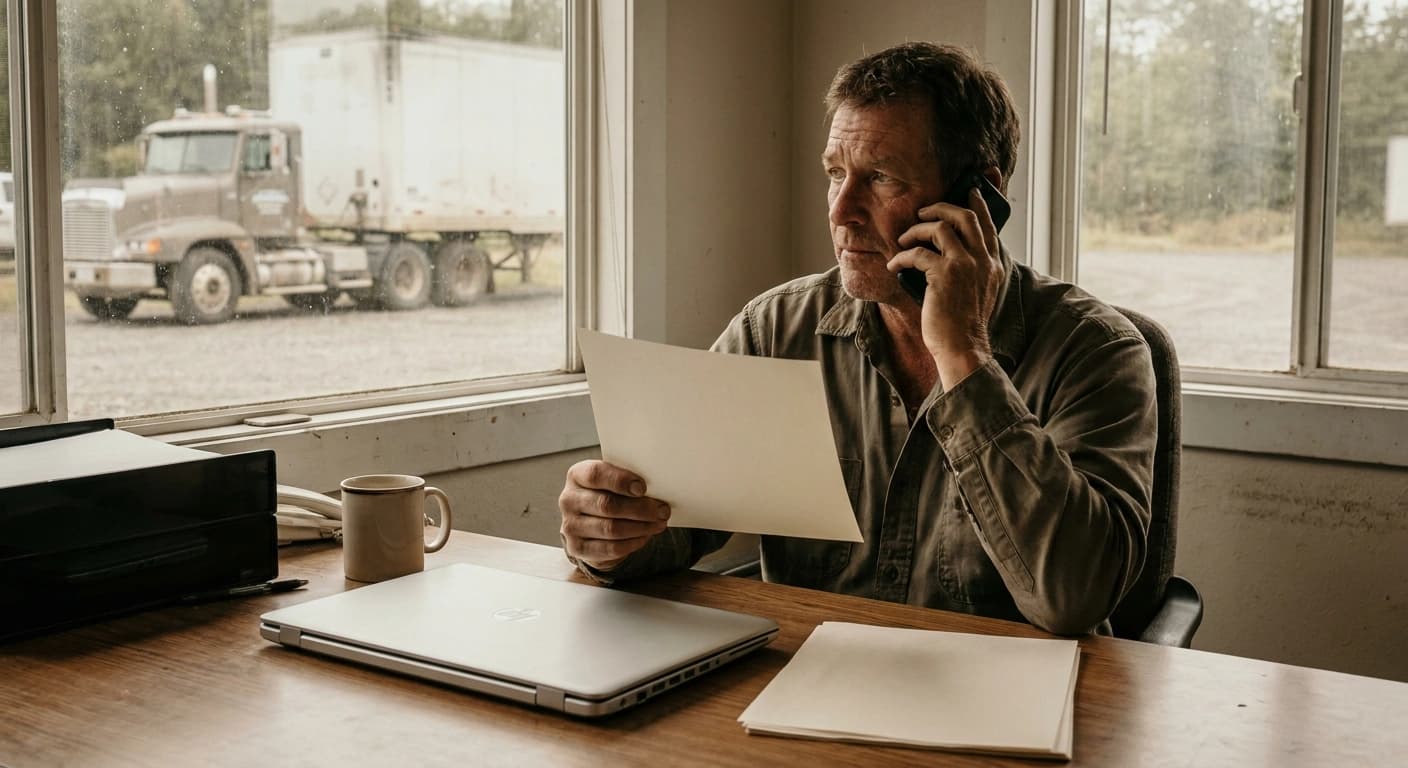
Self-dispatch means the owner, or a driver, books and runs the loads personally. Hiring a dispatcher means a salaried employee does that work, and an outside dispatch service does it for a percentage of each load's gross. The right choice depends less on how many trucks you run and more on how many hours of dispatch work your fleet actually generates, and what an hour of your own time is worth.
Most advice on this question gives you a truck count and stops there. A truck count is a shortcut. The real question is who does the dispatch chores, how long they take, and what each option costs in cash and in owner time. This post gives you a way to count those hours, a worked example, and a decision rule you can use on Monday.
What is the difference between self-dispatch and hiring a dispatcher?
There are three real options, not two.
- Owner self-dispatch. You (or a driver with a laptop in the sleeper) read the rate cons, assign the trucks, chase the check calls and file the paperwork. Cash cost is zero. The cost is your hours.
- A dispatcher on payroll. Someone works for you, sits at the board, and handles the chores. Cash cost is a salary plus everything that comes with an employee.
- An outside dispatch service. A company finds and books freight for you and usually charges a percentage of each load. Cash cost scales with your revenue.
The first two are about who runs the board. The third is different, because a dispatch service also finds freight. Keep that in mind when you compare quotes later.
How many hours does dispatch actually take?
Dispatch is not one job. It is a fixed set of chores that repeats for every load. Break one load down and it looks like this:
- Read the broker's rate confirmation and check the rate, stops, appointment times and reference numbers.
- Key the load into whatever you track loads in, whether that is a spreadsheet, a whiteboard or software.
- Pick the driver and truck, then send the driver the details.
- Answer "where are you" calls from the broker and make check calls to the driver.
- Collect the pickup paperwork and the delivery photo or paperwork.
- File it where you can find it when the broker or the factor asks.
Here is a worked example. These numbers are illustrative, not measured. Picture a 4-truck dry van fleet running about 20 loads a week.
| Chore per load | Minutes (illustrative) |
|---|---|
| Read and check the rate con | 5 |
| Key the load in | 6 |
| Assign the driver and send details | 4 |
| Check calls and broker "where are you" calls | 15 |
| Collect and file paperwork | 8 |
| Total per load | 38 |
At 20 loads a week, 38 minutes a load is about 12.7 hours. Add 30 minutes a day for the morning board and the end-of-day cleanup, and you are near 15 hours a week of pure dispatch chores. That does not include finding freight, negotiating rates or keeping brokers happy, which is the work that actually grows the business.
Your numbers will be different. The fastest way to find out is to count them. Put a stopwatch on your phone for five working days and log every minute you spend on the six chores above. Most owners guess low, because check calls arrive in two-minute pieces all day.
What does each option cost?
Here is the honest comparison. The outside figures come from one vendor's published article, so treat them as a rough benchmark, not market data.
TenTrucks says outside dispatch services "typically charge 5 to 10 percent of gross revenue per load," and puts a dispatcher hire at "roughly $50,000 to $75,000 per year all-in" (tentrucks.com/blog/self-dispatch-small-fleets, published June 4, 2026, fetched 2026-10-09). Its own example: a 3-truck fleet grossing around $90,000 a month, with a service at 7 percent, pays about $75,000 a year. TenTrucks also sells dispatch software, so read those figures as a vendor's framing.
Now run the arithmetic on our illustrative 4-truck fleet. Say it grosses $100,000 a month.
| Option | Cash cost per year (illustrative) | What you get |
|---|---|---|
| Owner self-dispatch | $0 | About 15 hours a week of your time |
| Dispatcher on payroll | $50,000 to $75,000 (TenTrucks' range) | Your hours back, someone at the board |
| Outside service at 5% | $60,000 | Dispatch plus freight booking |
| Outside service at 10% | $120,000 | Dispatch plus freight booking |
Two things move this table more than people expect.
First, ask what the percentage applies to. Some services charge on linehaul only, others on total gross including fuel surcharge and accessorials. On a fleet grossing $100,000 a month, that difference can be thousands of dollars a year.
Second, a percentage grows with you. A salary does not. The service that costs $60,000 a year at $100,000 a month costs $90,000 at $150,000 a month, for roughly the same chores.
When should an owner hand dispatch to someone else?
TenTrucks' rule of thumb is that "self-dispatch usually fits below 5 trucks," provided the owner "can spend two to four hours a day on operations." That is one vendor's rule, and it is a fair starting point. We would add a rule based on what the hours displace.
Hand off dispatch when either of these is true:
- Dispatch eats the hours you need to find freight, negotiate rates and keep brokers. If your best lanes come from relationships you build on the phone, every hour spent keying loads is an hour not spent on the work only you can do.
- A missed call costs you a load. If you are driving, sleeping, or in the shop when a broker calls with a good load and it goes to someone else, your dispatch coverage has a hole that costs real money.
If neither is true, self-dispatch is usually the right answer, and the 15 hours are cheaper than a salary.
If you do hand it off, decide which job you are handing off. A dispatcher on payroll runs your board. An outside service runs your board and finds freight. Those are different trades, and software is a third thing again: it books no freight at all. Howdy Dispatch does not find loads, does not book them, and does not replace a dispatcher or a dispatch service.
What does dispatch software change?
Software does not pick among the three options. It shrinks the chores, so the same person covers more trucks, or the owner gets hours back. Here is how that maps to the six chores, using what Howdy Dispatch does today.
- Read and key the rate con. The dispatcher uploads the broker's rate confirmation PDF, the AI reads it and pre-fills the load, and the dispatcher reviews and saves. Manual entry still works when a broker sends something odd. This is the one live AI feature on our AI dispatch platform.
- Assign and send. Pick the driver and truck from pre-loaded lists, and the driver gets a push notification on the iOS app.
- Check calls. The HQ live map shows trucks while the driver is on shift, and the shift clock stops location pings when the driver is off duty. A red chip flags any load that has waited more than 15 minutes, so one person can watch many loads without staring at them.
- Paperwork. The driver taps pickup with a load photo, captures the manifest, and taps delivery with a delivery photo. Every document on a load is reachable from that load in HQ, and lumper receipts attach to the load too.
We are not going to promise you a number of hours saved. We do not have customer results to point to, and your chores are your own. Count your week first, then see which chores the software takes over.
Just as important is what it does not do today. Howdy Dispatch does not do carrier invoicing, driver settlements or payroll, IFTA mileage, QuickBooks export or sync, ELD integration, load board integration, two-way chat or route optimization. It never accepts or dispatches a load on its own. The dispatcher decides.
If you want to see how this fits a real day, read a small fleet dispatcher's daily checklist, what AI does for a trucking dispatcher, or our guide to software for a small trucking company.
FAQ
Can a 3-truck fleet self-dispatch? Often, yes, if the owner has the hours. Count them for a week before deciding. If dispatch fits in two to four hours a day and is not costing you loads, self-dispatch usually wins on cash.
Is a dispatch service worth the percentage? It depends on two things: whether the service books freight you could not get yourself, and what the percentage is applied to. A service that only runs your board at 10 percent of total gross is an expensive dispatcher.
Do I still need a dispatcher if I use software? Yes, someone still has to decide. Software removes typing and chasing; it does not choose loads, drivers or rates.
How long does setup take with Howdy Dispatch? Set up within 48 hours. Howdy Dispatch is built for fleets of 1 to 50 trucks.
Can I try it? Yes. Look at Howdy Dispatch plans and the 14-day trial. The trial needs no payment method, so you can run your next week of loads through it and count the hours yourself.
READ NEXT
Roadside Inspection Documents Every Small Fleet Needs
Roadside inspection documentation for a small fleet: what your driver has to produce, what lives in the cab, and what has to be one tap away for dispatch.
Real-Time Truck Location: Book the Reload Before It Sits
Real-time truck location tells a dispatcher when to book the reload. With diesel at $5.31 a gallon in late July, guessing costs a small fleet real money.