

Cargo Damage Claim Photos: What Actually Decides Who Pays
A cargo damage claim can land nine months after delivery. Here is what the law asks a trucking carrier to prove, and which load photos decide who pays.
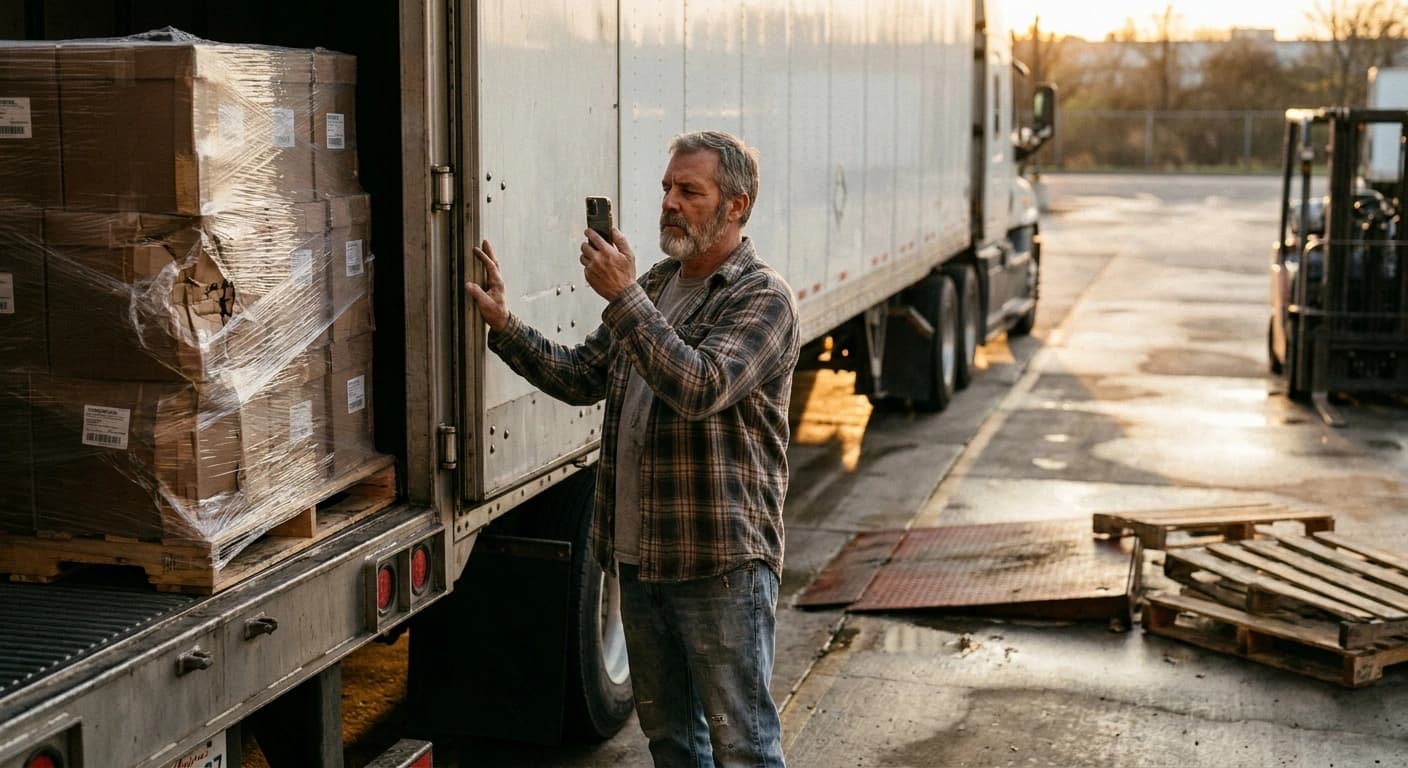
A claim shows up five months after a delivery you barely remember. Palletized tile, Dallas to Memphis, 452 miles at $2.65 a mile, one of a dozen loads you ran that week. The receiver says two pallets arrived crushed. The broker wants $6,400.
You go looking for proof. The driver who ran it left in March. His photos, if he took any, are on a phone you do not own. The signed delivery receipt is a photo of a photo in a group text. What you have is a memory and a feeling that the load left the yard fine.
That is the whole fight, right there. Not the tile. The record.
What the law actually puts on the carrier
Cargo liability for interstate motor freight runs through the Carmack Amendment, codified at 49 U.S.C. section 14706. It puts what lawyers describe as a near strict liability standard on motor carriers for the actual loss or injury to cargo.
Read that carefully, because it is not how most operators assume it works. Your negligence, or your total absence of negligence, is purposefully left out of the Carmack analysis. Being careful is not a defense on its own. You are close to an insurer of the freight from the moment you take it until the moment you hand it over.
That sounds brutal. It is survivable, and the reason is that the claimant has to prove something first, and then you get to prove something back. Both halves run on documentation.
The three things a claimant has to show
To make a prima facie case, the party filing the claim has to establish three elements:
- The carrier accepted the cargo in good condition, without exception.
- The cargo was delivered damaged relative to its condition at receipt.
- Substantiation for the value of the loss.
Element one is where small fleets bleed. "Without exception" means the bill of lading came back clean. If your driver signed a clean BOL at pickup and the freight was already scuffed, dented, wet, or short, you just handed the claimant element one for free.
A clean BOL is a statement, in writing, with your driver's signature on it, that the freight was fine when you took it. Every claim after that starts from your own admission.
The five defenses, and what each one needs
Once those three elements are established, the burden shifts to you. A carrier avoids Carmack liability by proving the loss came from one of five recognized causes:
- Act of God
- Act or default of the shipper
- Act of a public enemy, meaning war or terrorism
- Act of a public authority, meaning government action
- Inherent vice or nature of the goods
Now look at those as evidence problems instead of legal categories.
"Act or default of the shipper" usually means the shipper loaded it, blocked it, and braced it badly, or the shipper's own pallets were built wrong. Proving that takes a photograph of the trailer as it was loaded, before the doors closed.
"Inherent vice" means the commodity was going to do this on its own, and it usually takes a condition photo at pickup showing the freight already soft, swollen, leaking, or improperly packaged.
Every one of those defenses resolves to the same question. What did the freight look like when you took it, and can you show it?
The clock is longer than you think
Small fleets underestimate how long this hangs over a load.
Under 49 U.S.C. section 14706(e)(1), a carrier cannot require a claim to be filed in less than nine months after delivery. That nine months is a floor you must allow, not a deadline that protects you, and it is a common misreading in the other direction. After a written denial, the claimant then has two years to file suit.
On your side of it, 49 CFR Part 370 sets the response rules. You or your adjuster must acknowledge a properly filed claim in writing within 30 days. Within 120 days you must pay it, decline it, or make a firm settlement offer in writing, or keep issuing status updates until you can.
So the practical horizon on any load you run today is roughly this: someone can bring a claim against it the better part of a year from now, and litigation can trail two years past that. The driver will be gone. Your memory will be gone. The file is the only thing that survives.
Why the camera roll loses claims
Most small carriers already take pickup and delivery photos. They still lose claims, for three reasons that have nothing to do with effort.
The photos live on the wrong device. They are in a driver's personal camera roll. When he leaves, the evidence leaves with him, and you have no right to any of it.
They are not attached to the load. A photo in a group text is not indexed to a load number, a date, or a lane. Nine months later, nobody can find the four images that matter inside 3,000 unsorted photos.
Nobody checked them when checking was still possible. A blurry BOL is a fixable problem for about ninety seconds, while the driver is still standing at the dock. Three weeks later, when a broker short-pays the invoice, it is unfixable forever.
That last one is the expensive one. The photo existed. It just could not be read.
What a defensible load file looks like
Concept level, not a script. A load you can defend nine months out has five things attached to it, and all five have to be captured automatically as a byproduct of the driver doing his job. Anything that depends on a driver remembering an extra step will fail in the rain at 4 a.m.
- Condition at pickup. The freight and, where you can get it, the loaded trailer before the doors close.
- The paperwork as signed. The BOL as it actually read at pickup, exceptions and all, legible enough to enlarge.
- Timestamps and location. When the truck arrived, when it left, where it was.
- Condition at delivery. The same freight, at the consignee, before it comes off.
- Anything that went sideways in between. Weather, a breakdown, a DOT stop, a shift in the load.
That last category matters more than most operators expect. A claim gets a lot cheaper when you can show a documented mid-route event with photos and a timestamp, rather than arguing about it from memory.
Where those photos have to come from
This is the part a spreadsheet cannot solve. The evidence originates at the dock, on a phone, in the hands of somebody who is trying to get loaded and gone.
Howdy Dispatch is an AI dispatch platform built on both sides, HQ and a real iOS driver app, and the load file is a byproduct of the normal flow rather than a separate chore. The driver taps pickup and captures a load photo. He captures the manifest. He taps delivery and captures a delivery photo. GPS runs continuously on the HQ live map, and a detention timer tracks pickup and delivery wait against the appointment window. Every image lands in the driver document gallery on that load's detail page, on the company's account, not on his phone.
Mid-load incident reporting covers the in-between. A driver reports cargo damage, an accident, a mechanical breakdown, a DOT inspection or traffic stop with structured officer and citation fields, weather delays, or a theft attempt, with photo evidence attached to the load. Every dispatcher, admin, and owner on the account gets a push the moment it is filed. That is your contemporaneous record, created on the day, not reconstructed later.
Driver photo uploads are compressed on the device before they send, which is why this still works on bad LTE at a dock in the middle of nowhere, and status changes queue in an offline outbox and drain when signal comes back.
One honest gap, stated plainly: today nothing checks whether the photo is readable. AI photo quality checking on driver uploads, blur and legibility detection at the moment of upload so the driver can reshoot while he is still standing there, is shipping next and is not live yet. You can see where it sits on the AI dispatch platform page.
What to do with this on Monday
You do not need software to start. You need a policy your drivers can follow without thinking.
- Stop signing clean BOLs by reflex. If the freight looks wrong, note the exception on the document before anyone signs, and photograph it.
- Photograph the load before the doors close, every time, not just on freight that looks fragile.
- Get the photos off personal phones and onto something the company owns. This is the single highest-value change available to a small fleet, and it costs nothing but a decision.
- Keep the rate confirmation, the BOL, the POD, and the photos in one place, indexed to the load.
- When a claim lands, calendar the 30-day acknowledgment and the 120-day decision immediately.
What Howdy Dispatch is not
This topic borders compliance and insurance, so the boundaries matter.
Howdy Dispatch is not an Electronic Logging Device under 49 CFR Part 395. It is not a freight broker, a carrier of record, or a freight forwarder. It is not cargo insurance, and it does not adjust, file, or defend claims. It does not verify FMCSA authority, safety scores, or insurance status. Nothing here is legal advice, and a real cargo claim of any size belongs with your insurer and your attorney.
What the platform does is make sure that when they ask what you have, the answer is not a shrug.
Build the file before you need it
Nobody photographs a load thinking about a lawsuit. They photograph it because tapping a button was easier than not tapping it. That is the whole trick. The fleets that win claims are not more diligent than you. Their documentation just happens automatically, so it is still there nine months later when it finally matters.
If you want to see what that looks like on your own loads, there is a 14-day free trial at howdydispatch.com/pricing, and carriers who want to shape the roadmap can ask about the founding-carrier program at howdydispatch.com/contact.
READ NEXT
Why Your Drivers Won't Use the App (and How a Small Fleet Actually Gets Adoption)
Most trucking driver apps die from non-adoption, not features. Here is why small-fleet drivers ignore apps, and the checklist to get them actually using one.
Four Documents Win a Freight Dispute. Three of Them Die in a Driver's Camera Roll.
When a broker disputes an invoice, the carrier with the paperwork wins. Here is why BOLs and PODs vanish into a phone, and how a real driver app fixes it.